
Police Science Certificate at Carteret: 12-Week Fast Track
Earn a Criminal Justice/Police Science Certificate at Carteret Community College in 12 weeks to under a year, in person, and step into law enforcement or security faster.

By Julian Walsh
You can complete a Criminal Justice/Police Science Certificate, 12 weeks to less than 1 year In-person at Carteret Community College, and walk away with job-ready skills and a credential that signals commitment to public safety. For students who want a fast, affordable path into law enforcement, corrections, or security work, this program packs practical training into a single academic year. It also stacks neatly into an associate degree if you decide to go further. In this guide, you will see what the certificate covers, how to pay for it, how to fit it into a busy schedule, and why it can be a smart first step before you apply to a police academy or transfer to a four-year criminal justice program.
What the Criminal Justice/Police Science Certificate Covers
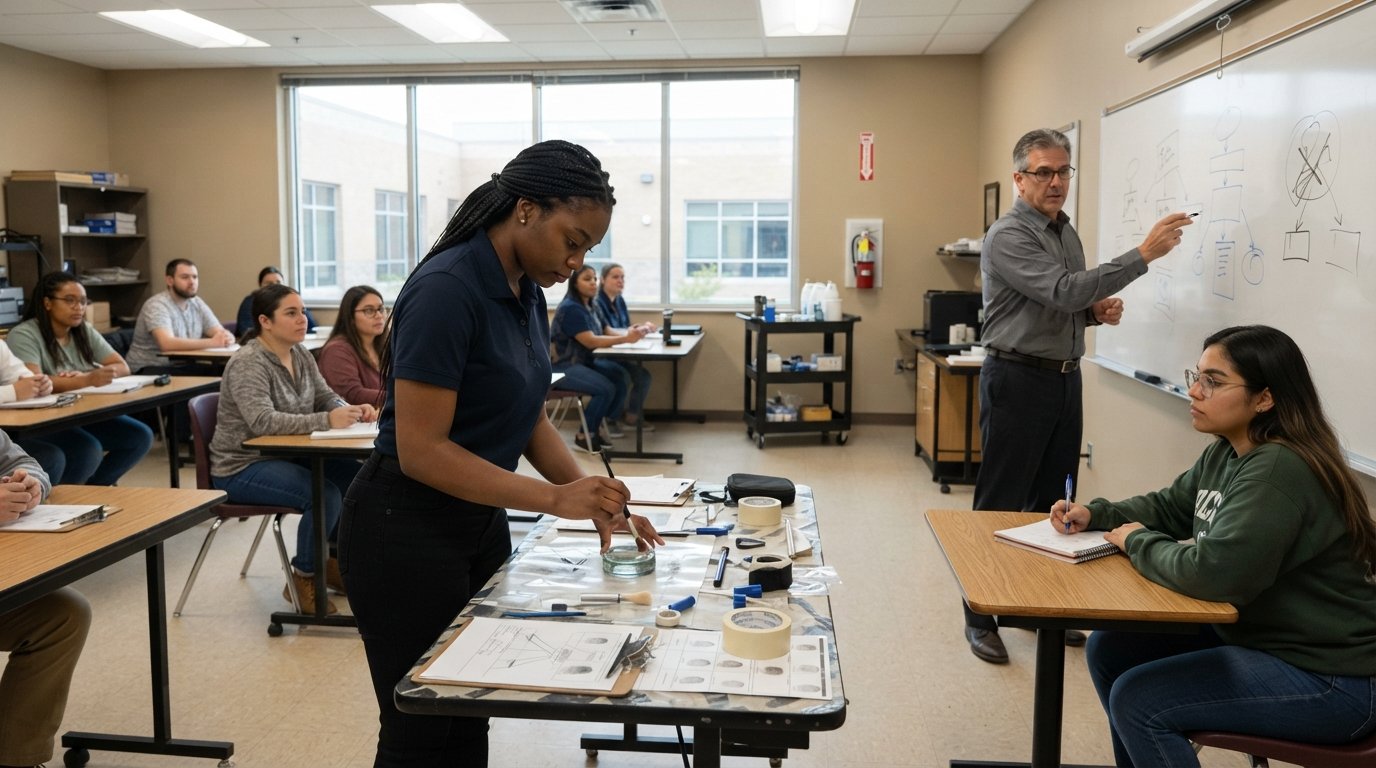
The certificate is built for students who want a structured, hands-on introduction to the criminal justice system without committing to a two-year or four-year degree. At Carteret Community College, the program is delivered in person, which matters in this field: you learn report writing, interview techniques, and evidence handling by practicing them, not just reading about them. Coursework typically blends criminal justice fundamentals with police science skills, giving you a realistic picture of what the work demands.
Expect a curriculum that touches on the major components of the justice system: law enforcement, courts, and corrections. You will likely study criminal law, constitutional protections, patrol procedures, and community relations, along with written and verbal communication skills that are essential on the job. Many police science certificate programs also include physical fitness and defensive tactics modules, though the exact lineup varies by cohort and semester. Because the program takes 12 weeks to less than 1 year, the pace is brisk, and attendance matters. Students who treat it like a full-time job tend to get the most out of it.
One of the strongest features of a certificate like this is its stackability. Credits earned often apply toward an associate degree in criminal justice or a related field, so you are not wasting time if you later decide to pursue a diploma or transfer. That flexibility is especially valuable for working adults and for students who are not yet sure whether they want to become sworn officers, work in corrections, or move into private security and loss prevention. The certificate lets you test the waters with a low financial and time commitment.
Who Should Enroll in This In-Person Program
This certificate is a good fit for several groups. First, recent high school graduates who want to enter the workforce quickly and build a resume before applying to a police academy. Second, career changers who are drawn to public service but need a credential and some foundational knowledge before making a full leap. Third, current security guards, detention officers, or military personnel who want formal training that supports promotion or a transition into civilian law enforcement. Finally, students who plan to earn a criminal justice degree but want to start with a short, affordable credential that counts toward the larger goal.
Because the program is in person, it also suits learners who thrive in a structured environment with direct access to instructors who have field experience. Many community college criminal justice instructors are retired officers, sheriffs, or corrections professionals, and that mentorship can be as valuable as the textbook material. If you are the kind of student who benefits from hands-on demonstrations, role-play scenarios, and immediate feedback, an in-person police science certificate is likely a better fit than a fully online alternative.
It is worth being honest about who should wait. If you are unsure whether you can attend class consistently for the duration of the program, or if you need a fully asynchronous schedule, this may not be the right moment. The 12 weeks to less than 1 year timeline is efficient precisely because it is intensive. Students who can clear their schedule and treat the certificate as a priority tend to finish strong and leave with strong references from instructors.
Admissions Steps and What to Prepare
Community college certificate programs are generally accessible, but criminal justice and police science programs often have additional requirements because of the nature of the field. You should expect a standard college application, placement testing or exemption, and possibly a background check or physical readiness form before you begin certain courses. The exact steps vary, so confirm details with the program coordinator before the term starts. The earlier you begin, the more likely you are to secure a seat in a cohort that fits your schedule.
Here is a practical sequence to follow as you prepare to enroll:
- Complete the college application and submit official transcripts from any prior institutions.
- Take any required placement tests or provide scores that qualify you for college-level English and math.
- Meet with an academic advisor to map the certificate courses and confirm the in-person schedule.
- Complete financial aid steps, including the FAFSA, and ask about institutional scholarships and payment plans.
- Clear any program-specific requirements such as a background check or health and fitness forms before the first day.
After you complete those steps, keep a copy of your schedule and syllabi in one place. Because the program is short, a single missed registration deadline can push your start date back by a full semester. Advisors can also help you plan for the next step, whether that is an associate degree, a police academy application, or a job search in corrections or private security. If cost is a concern, ask specifically about tuition waivers, workforce grants, and any partnerships the college has with local agencies.
Paying for the Certificate: Aid, Scholarships, and Planning
Cost is often the biggest question for students considering a criminal justice certificate. The good news is that short certificate programs are usually far less expensive than full degree programs, and they often qualify for federal student aid if the program is eligible. Start by filing the FAFSA, then talk with the financial aid office about Pell Grants, state grants, and work-study options. Many community colleges also offer payment plans that spread tuition across the term, which can make the 12 weeks to less than 1 year format more manageable for working students.
Scholarships are another important lever. Criminal justice students can pursue general community college scholarships, local law enforcement association awards, and national opportunities aimed at future officers and public safety professionals. Our guide to criminal justice scholarships for college students outlines where to look and how to strengthen an application. Pair that with a conversation with the college's foundation office, which often administers donor-funded awards specifically for workforce and public safety programs.
For a broader view of college costs and financial planning, resources like CollegeAndTuition can help you compare expenses and understand how aid packages work. When you are ready to explore degree options after the certificate, Scholarship.Education's program search tools can connect you with criminal justice and public safety programs at partner institutions. Note that Scholarship.Education receives compensation from listed schools through advertising, links, and search placement, which may influence how schools appear and rank. Always confirm accreditation, total costs, and program outcomes directly with the college before enrolling.
Building a Career After the Certificate
The certificate alone does not make you a sworn police officer. Most states require candidates to complete a certified basic law enforcement training academy and pass a licensing exam before they can work as officers. What the certificate does is prepare you for that next step and make you a more competitive applicant. It demonstrates that you understand the basics of criminal law, procedure, and report writing, and it gives you instructors who can speak to your readiness in a reference letter. For corrections, private security, loss prevention, and emergency communications roles, the certificate can be enough to help you land an entry-level position and start earning while you decide on a longer-term path.
Students who want to advance should think about stacking credentials. A common route looks like this: certificate first, then an associate degree in criminal justice, then a bachelor's degree if you are aiming for supervisory, federal, or specialized roles. Each step builds on the last, and many employers offer tuition assistance for criminal justice coursework. If you are considering a four-year degree, compare online and in-person options carefully, and check whether your certificate credits transfer. Advising early prevents duplicate coursework and saves money.
Networking matters in this field. While you are enrolled, attend any career fairs, agency visits, or ride-along opportunities the program arranges. Introduce yourself to local recruiters and ask about their hiring timelines. A short certificate program is as much about relationships as it is about coursework, and students who engage with instructors and visiting agencies often hear about openings first. Keep a simple portfolio of your projects, certifications, and fitness benchmarks so you can speak concretely about your preparation in interviews.
Why the In-Person Format Matters
Online learning has its place, but police science is a performance field. In-person instruction gives you access to scenario training, physical fitness sessions, and immediate correction from experienced instructors. You learn how to speak to people in crisis, how to write a report that holds up in court, and how to handle evidence correctly, all skills that are hard to master through a screen. The in-person format also builds the professional habits that agencies look for: punctuality, teamwork, and composure under pressure.
The compressed timeline is another advantage. A 12 weeks to less than 1 year program keeps momentum high and lets you enter the job market or academy pipeline quickly. For students paying out of pocket or using limited aid, finishing fast reduces the total cost and the opportunity cost of time out of the workforce. It also gives you a clear finish line, which helps with motivation. If you are comparing programs, weigh schedule, cost, and hands-on time, not just the credential name. A local, in-person certificate at a community college can be a stronger launchpad than a longer online program that lacks practical training.
Finally, consider fit with your life. Carteret Community College serves a coastal region with strong ties to public safety agencies, and local programs often have direct relationships with nearby departments. That proximity can translate into internships, ride-alongs, and informal referrals. Ask the program coordinator which agencies have hired recent graduates and whether there are articulation agreements with four-year schools. Those details tell you more about a program's real value than any brochure.
If you are ready for a fast, affordable, and practical start in criminal justice, the Criminal Justice/Police Science Certificate, 12 weeks to less than 1 year In-person at Carteret Community College is worth a serious look. Confirm the current schedule and admissions steps with the college, file your financial aid early, and plan your next credential before you finish. A short program can open a long career, and the students who plan ahead are the ones who make the most of it.