
Brazosport College Machinist Certificate: 12-Week Path
The Machine Tool Technology/Machinist Certificate at Brazosport College can be completed in 12 weeks to under a year, launching hands-on manufacturing careers fast.

By Priya Foster
Skilled machinists are in demand across Texas and the nation, and the fastest route into this trade often runs through a short, hands-on certificate program. The Machine Tool Technology/Machinist Certificate, 12 weeks to less than 1 year In-person at Brazosport College gives students a concentrated path to foundational machining skills without committing to a multi-year degree. For anyone weighing a quick pivot into manufacturing, this program deserves a close look.
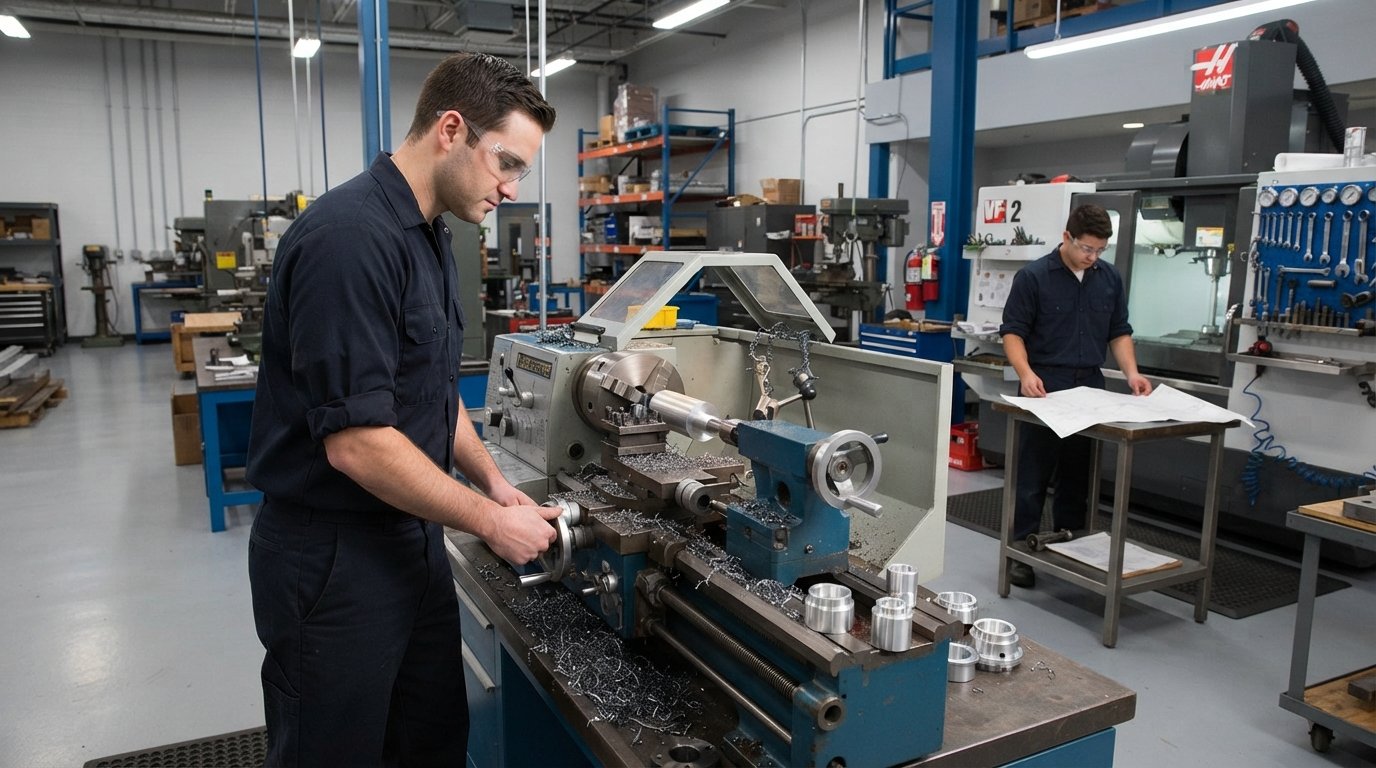
Brazosport College, located in Lake Jackson, Texas, offers this in-person credential through its technical education division. Students learn on manual lathes, mills, and modern CNC equipment, building the kind of tactile competence that employers value on the shop floor. Because the program can be completed in as little as 12 weeks and no longer than one year, it appeals to career changers, recent high school graduates, and working adults who need flexibility.
What the Machine Tool Technology/Machinist Certificate Covers
The curriculum centers on the core competencies of precision metalwork. Students begin with shop safety and measurement, then progress to setup and operation of conventional machine tools. Blueprint reading, tolerance analysis, and geometric dimensioning and tolerancing are woven into the coursework so that students learn to interpret engineering drawings accurately.
As the program advances, learners transition to computer numerical control (CNC) operations. They write and edit basic G-code, set tool offsets, and run production-style parts on CNC mills and lathes. Instructors emphasize inspection techniques, including the use of calipers, micrometers, and height gauges, because quality control is central to any machining role.
Typical coursework in a program of this type includes:
- Shop safety and precision measurement
- Blueprint reading and GD&T fundamentals
- Manual lathe and milling machine operations
- CNC programming, setup, and operation
- Inspection and quality assurance practices
Because the certificate is delivered in person, students spend significant time at the machine, not just in a classroom. That hands-on repetition is what separates a certificate holder from someone who has only read about machining. Employers consistently report that new hires who have actually cut metal, crashed a tool or two, and learned to recover are far more productive in the first 90 days.
Why 12 Weeks to Less Than 1 Year Matters
Time is money, and for adult learners especially, a short program can mean the difference between pursuing training and putting it off indefinitely. The Machine Tool Technology/Machinist Certificate, 12 weeks to less than 1 year In-person at Brazosport College is designed so students can enter the workforce quickly. A 12-week completion track is possible for focused, full-time students, while part-time or working students may take closer to a year.
This flexibility is a major selling point. Someone laid off from an unrelated industry can retrain and be interviewing for machinist roles within a single semester. A high school senior can stack the certificate with dual credit or start immediately after graduation. And an incumbent worker in manufacturing can upskill without pausing their income for years.
Short programs also reduce the total cost of attendance. Fewer semesters mean less tuition, fewer fees, and less time out of the labor market. When you compare the certificate to a two-year associate degree, the return on investment can be compelling, particularly for entry-level roles where employers care more about demonstrated skill than the letters after your name.
For students exploring similar accelerated options outside Texas, our guide to the CNC machinist certificate at Allegany shows how another 12-week program structures its training. Comparing formats and timelines helps you choose the path that fits your schedule and budget.
Admission Requirements and How to Enroll
Admission to a technical certificate at a Texas community college is generally straightforward. Applicants typically need a high school diploma or GED, completion of a college application, and placement in college-level reading and math or the willingness to take developmental coursework. Some programs require a brief advising session or a department orientation before registration.
Because the program is in person, students should also consider logistics: commute time to the Lake Jackson campus, availability of evening or daytime sections, and whether financial aid or workforce grants can offset costs. Brazosport College participates in federal student aid, and Texas offers workforce training grants that may apply to short-term certificates.
A practical enrollment sequence looks like this:
- Submit the college application and any required transcripts.
- Complete placement testing or submit qualifying scores.
- Meet with a program advisor to map the certificate plan.
- File the FAFSA and ask about workforce or scholarship funding.
- Register for classes and attend the mandatory safety orientation.
Prospective students should confirm current start dates and cohort sizes with the college, since technical programs often admit students in fall, spring, and summer terms. Early application improves access to financial aid and preferred class times.
Paying for the Certificate: Financial Aid and Funding Options
Cost is often the biggest barrier for career-training students, but several funding streams can help. Federal Pell Grants can cover a substantial portion of tuition for eligible students in certificate programs of sufficient length. Texas also offers the Texas Public Educational Grant and workforce-specific grants through the Texas Workforce Commission.
Scholarships are another avenue. Local manufacturers, trade associations, and community foundations frequently fund machinist training because they need skilled workers. Students should search for scholarships tied to manufacturing, STEM, and vocational education, and should ask the college financial aid office about institutional awards.
For a broader look at how families can plan and pay for education at every level, resources like CollegeAndTuition provide plain-language guidance on college costs, aid applications, and affordability strategies. Pairing that general knowledge with program-specific aid questions gives students a stronger financial plan.
Employer tuition assistance is worth asking about as well. Some manufacturing firms will reimburse tuition for employees pursuing machining credentials, especially if the skills align with the company's production needs. Apprenticeship-linked programs may also combine paid work with related instruction.
Career Outcomes and Salary Expectations
Machinists set up and operate machine tools to produce precision parts and instruments. They work in aerospace, oil and gas, medical device manufacturing, automotive, and general job shops. The Gulf Coast region, with its concentration of energy and petrochemical employers, offers a particularly deep market for skilled machinists.
Entry-level pay varies by region and industry, but machinists in Texas generally earn competitive hourly wages with opportunities for overtime. CNC operators and programmers often command higher pay as they gain experience. Advancement paths include lead machinist, CNC programmer, quality inspector, tool and die maker, and shop supervisor.
Students should keep expectations realistic: a certificate opens doors, but mastery comes with time on the job. Employers value reliability, attention to detail, and the ability to read prints and hold tolerances. Those who continue learning, whether through additional certifications or an associate degree, tend to move up faster.
Is the Machinist Certificate Right for You?
This program suits people who enjoy working with their hands, solving spatial problems, and seeing a tangible product at the end of the day. It rewards patience and precision. If you prefer desk work or dislike repetitive tasks, machining may not be a fit. But for those who thrive in a shop environment, the trade offers stability and a clear ladder.
The Machine Tool Technology/Machinist Certificate, 12 weeks to less than 1 year In-person at Brazosport College is a practical entry point. It is short enough to be affordable and long enough to build real competence. Before enrolling, visit the campus, talk to instructors, and ask about job placement support. A short conversation can confirm whether the program matches your goals.
For students comparing options, weigh the certificate against longer degree programs and against other short programs in the region. Consider total cost, time to completion, and employer connections. The right choice is the one that gets you the skills you need at a price and pace you can sustain.
Take the next step by contacting Brazosport College admissions, filing your FAFSA, and exploring scholarship databases for manufacturing-related awards. With planning, a machinist career can begin in a single semester.