
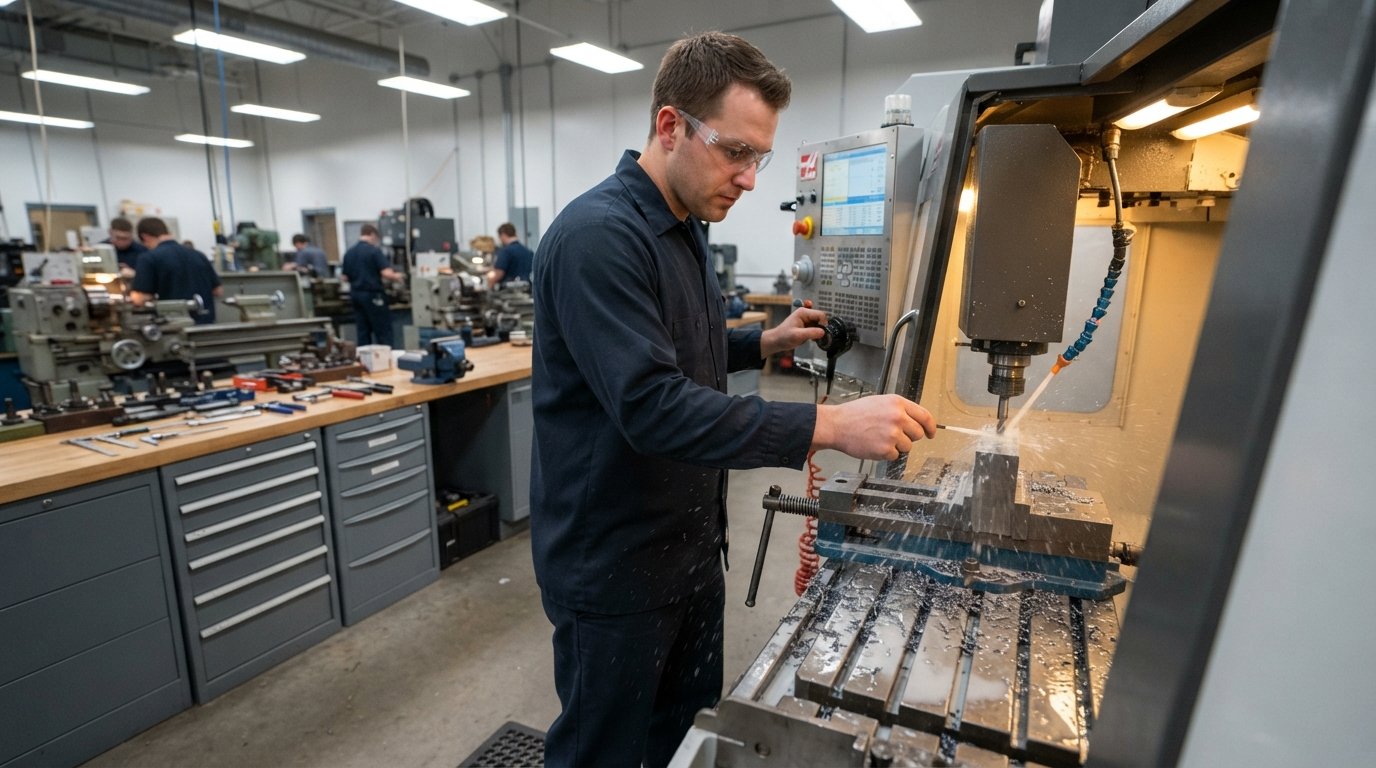
CNC Machinist Certificate: 12-Week Training at Allegany
Earn a CNC Machinist Certificate at Allegany College of Maryland in 12 weeks to under a year. Hands-on training that leads straight to skilled manufacturing jobs.

By Harper Davis
Manufacturing in the United States is not disappearing: it is evolving into a high-tech industry that runs on precision, software, and skilled hands. At the center of that evolution sits the CNC machinist, a professional who programs and operates computer-controlled machine tools that cut metal, plastic, and composite parts to tolerances measured in thousandths of an inch. If you are searching for a fast, affordable, and hands-on route into this field, the Computer Numerically Controlled (CNC) Machinist Technology/CNC Machinist Certificate, 12 weeks to less than 1 year In-person at Allegany College Of Maryland deserves a serious look. It is a short-format credential that trades years of theory for concentrated shop-floor practice, and it can put you in front of real machines and real employers far sooner than a traditional two-year or four-year degree.
Why Short-Format CNC Training Makes Sense Right Now
The economics of career training have shifted. Students are increasingly skeptical of long degree programs that carry heavy debt and uncertain job pipelines. Certificate programs, by contrast, are built around a simple promise: teach a defined skill set, verify it with hands-on assessment, and send graduates into an industry that is actively hiring. The CNC Machinist Certificate at Allegany College of Maryland fits that model almost perfectly, because machining is a discipline where employers care far more about what you can produce on a machine than about how many semesters you sat in a lecture hall.
Advanced manufacturing employers in Maryland, Pennsylvania, and the broader Mid-Atlantic region consistently report a shortage of entry-level machinists who can read a print, set up a machine, and hold a tolerance without constant supervision. That gap is exactly what a 12-week to under-one-year certificate is designed to close. You learn the language of the trade (blueprint reading, GD&T, feeds and speeds, work offsets) and then you apply it daily in a lab, which is where the learning actually sticks.
The financial case is equally straightforward. A shorter program means lower tuition, fewer months out of the workforce, and a faster return on your investment. If you are weighing a certificate against a degree, it helps to understand how credential stacking works and how different pathways compare, and resources such as CollegeDegrees.School offer useful guidance on college degrees, higher education pathways, and career planning for students and career changers alike. For many people, a certificate is not a dead end: it is the first rung of a ladder that can later include an associate degree, advanced CNC programming credentials, or supervisory roles.
Inside the CNC Machinist Certificate at Allegany College of Maryland
Allegany College of Maryland, often shortened to ACM, is a public community college based in Cumberland, Maryland, with a regional reputation for workforce and technical education. Its Computer Numerically Controlled (CNC) Machinist Technology/CNC Machinist Certificate is delivered in person, which matters enormously in this field. You cannot learn to feel a cutting tool engage metal by watching a video. You learn it by standing at a machine, adjusting a dial, listening to the cut, and seeing the chip formation change.
Because the program can be completed in as little as 12 weeks and no longer than one year depending on your schedule and course sequencing, it attracts a wide range of students: recent high school graduates, displaced workers, veterans, and people who already work in a shop and want formal credentials to move up. The in-person format also means small cohorts, direct instructor feedback, and access to the same categories of equipment you will encounter on a real production floor.
Across a typical CNC machinist certificate curriculum, the core competencies you should expect to build include:
- Blueprint reading and geometric dimensioning and tolerancing (GD&T), the grammar of every machining job.
- Manual machining fundamentals on lathes and mills, which build the feel and judgment that CNC operators need.
- CNC setup and operation, including workholding, tool offsets, and safe startup and shutdown procedures.
- G-code programming basics and interpretation of CNC programs at the control.
- Precision measurement with calipers, micrometers, height gauges, and indicators, plus quality inspection habits.
- Shop safety, machine maintenance, and the professional work habits employers expect.
What separates a strong certificate from a weak one is how much time you spend actually making parts. When you tour or contact the program, ask directly how many lab hours per week are scheduled, what machine models are in the lab, and whether students write and prove out their own programs or only run instructor-prepared ones. The answers will tell you how job-ready you will be on day one after graduation.
What a Typical Week Looks Like as a CNC Student
Short-format programs are intensive by design. A 12-week track often runs like a full-time job, with several hours of classroom instruction paired with substantial lab blocks each week. A longer sequence spread across two semesters will feel more like a traditional college schedule. Either way, the rhythm of the week tends to follow a recognizable pattern.
Classroom sessions cover the theory: how to interpret a drawing, how to calculate speeds and feeds, how coordinate systems work, and why certain toolpaths are more efficient than others. Then you move to the lab, where that theory meets reality. You will set up a vise or chuck, touch off tools, load a program, run a first article, measure it, and adjust. Mistakes are expected and are part of the process; a scrapped part in a supervised lab is a cheap lesson compared to a scrapped production run on the job.
By the end of the program, most students can point to a portfolio of parts they made themselves, which is one of the most persuasive things you can bring to an interview. Employers rarely ask to see your transcript. They ask what you can set up, what controls you have used, and whether you can read a print without help.
Jobs, Salaries, and Career Paths After the Certificate
The CNC machinist certificate is a direct-to-work credential. Graduates typically enter the field as entry-level CNC machine operators, setup operators, or apprentice machinists. From there, the career ladder in advanced manufacturing is unusually clear and merit-based. Machinists who master setup and programming often move into CNC programmer roles, quality inspection and CMM operation, tool and die work, or shop supervision. Some eventually start their own job shops.
Pay in this field rewards skill and versatility more than seniority alone. Entry-level operators in the Mid-Atlantic region typically start in a range that supports a stable working life, and machinists who can program, set up, and troubleshoot multiple machine types earn meaningfully more. Overtime is common in busy shops, and skilled machinists are among the more recession-resistant manufacturing workers because precision parts are needed across aerospace, medical devices, defense, automotive, and energy supply chains.
It is worth noting that the industry is not standing still. Modern shops increasingly combine CNC machining with automation, robotics, and digital inspection, which means a certificate graduate who is comfortable with technology has an edge. If you eventually want to move into engineering technology, manufacturing management, or quality engineering, the certificate can serve as a foundation that you build on later with additional coursework.
Paying for CNC Training: Financial Aid, Scholarships, and Grants
Cost is often the deciding factor for career-training students, and it is where a community college certificate shines. As a public institution, Allegany College of Maryland offers tuition rates that are dramatically lower than private trade schools, and certificate students may qualify for federal student aid, state workforce grants, and institutional scholarships. Because the program is short, even modest grant awards can cover a substantial share of the total cost.
Several funding avenues are worth investigating before you enroll:
- Complete the FAFSA, the Free Application for Federal Student Aid, even if you think you will not qualify. Many state and institutional programs use it as the starting point.
- Ask the college's financial aid office about Pell Grants, which do not need to be repaid, and about any workforce development waivers for in-demand programs.
- Check Maryland state workforce programs and local workforce development boards, which frequently fund short-term training in manufacturing and the skilled trades.
- Look for scholarships aimed at career and technical education students, veterans, and adult learners returning to school.
- Ask your employer, if you are already in a related job, whether tuition assistance or reimbursement is available.
Scholarship databases and financial aid guides can make this search far less overwhelming, and sites like Scholarship.Education maintain free tools, deadline calendars, and application guides that help students find and win funding for exactly this kind of program. Note that Scholarship.Education receives compensation from listed schools through advertising, links, and search placement, which may influence how schools appear and rank; the information is provided for general reference and is not legal, academic, or career advice. Treat any single source as a starting point, and always confirm details directly with the college's financial aid office.
How to Decide If This Program Fits You
The strongest candidates for a CNC machinist certificate share a few traits: they like working with their hands, they are comfortable with basic math and computers, they take pride in precision, and they want to start earning without a four-year detour. If you enjoy solving physical problems, do not mind standing for much of the day, and want a skill that travels well across industries and states, this pathway is a strong match.
Before committing, take these practical steps: visit the campus or attend an information session, tour the machine lab, talk to an instructor about placement rates and employer partners, meet with financial aid, and map out whether you can handle the 12-week intensive pace or should choose the longer sequence. Ask current students what surprised them most. Their answers will be more honest than any brochure.
It also helps to think two steps ahead. Where do you want to be in three years? If the answer is "running my own machine and earning a solid wage," the certificate alone may be enough. If the answer is "engineering or shop management," plan now for how you will stack additional credentials later. Either way, the first move is the same: get hands-on training, get hired, and let real shop experience teach you what you want next.
Manufacturing needs people who can make things accurately and reliably, and the Computer Numerically Controlled (CNC) Machinist Technology/CNC Machinist Certificate, 12 weeks to less than 1 year In-person at Allegany College Of Maryland is one of the most efficient on-ramps available in the region. Short, affordable, hands-on, and aligned with real hiring demand, it turns a vague interest in machines into a marketable skill in under a year. If you have been waiting for a practical reason to start, this is it: the machines are running, the employers are hiring, and the next cohort is forming now.