
Environmental Science Bachelor's Degree at College of Coastal Georgia
Explore the Environmental Science Bachelor's degree at College of Coastal Georgia: a flexible four-year mix of in-person and online study with coastal field experience.

Coastal Georgia is more than a backdrop for a college experience; it is a living laboratory. With salt marshes, tidal creeks, barrier islands, and a working port within reach, the region offers an ideal setting for students who want to study the environment where the science actually happens. The College of Coastal Georgia (CCGA) has built its Environmental Science Bachelor's degree around that advantage, blending classroom instruction with field work and a flexible mix of in-person and online courses. If you are mapping out a path toward a career in conservation, environmental policy, or marine science, this program deserves a close look, especially because the combination of hands-on learning and online flexibility can keep costs and scheduling pressures manageable while you earn your degree.
This guide walks through what the program covers, how the in-person and online mix works, what it costs and how to fund it, and how to decide whether CCGA is the right fit for your goals. Along the way, you will find practical steps for applying, paying for college, and building a resume while you study.
What the Environmental Science Bachelor's Degree at CCGA Covers
The Environmental Science degree at College of Coastal Georgia is typically a four-year program designed to give students a broad foundation in the natural sciences while allowing them to specialize in areas that match their career interests. You should expect coursework in biology, chemistry, geology, and ecology, along with upper-level classes in environmental policy, geographic information systems (GIS), and natural resource management. The program is structured to help students understand how ecosystems function and how human activity interacts with them, which is exactly the kind of knowledge employers in conservation, government, and industry are looking for.
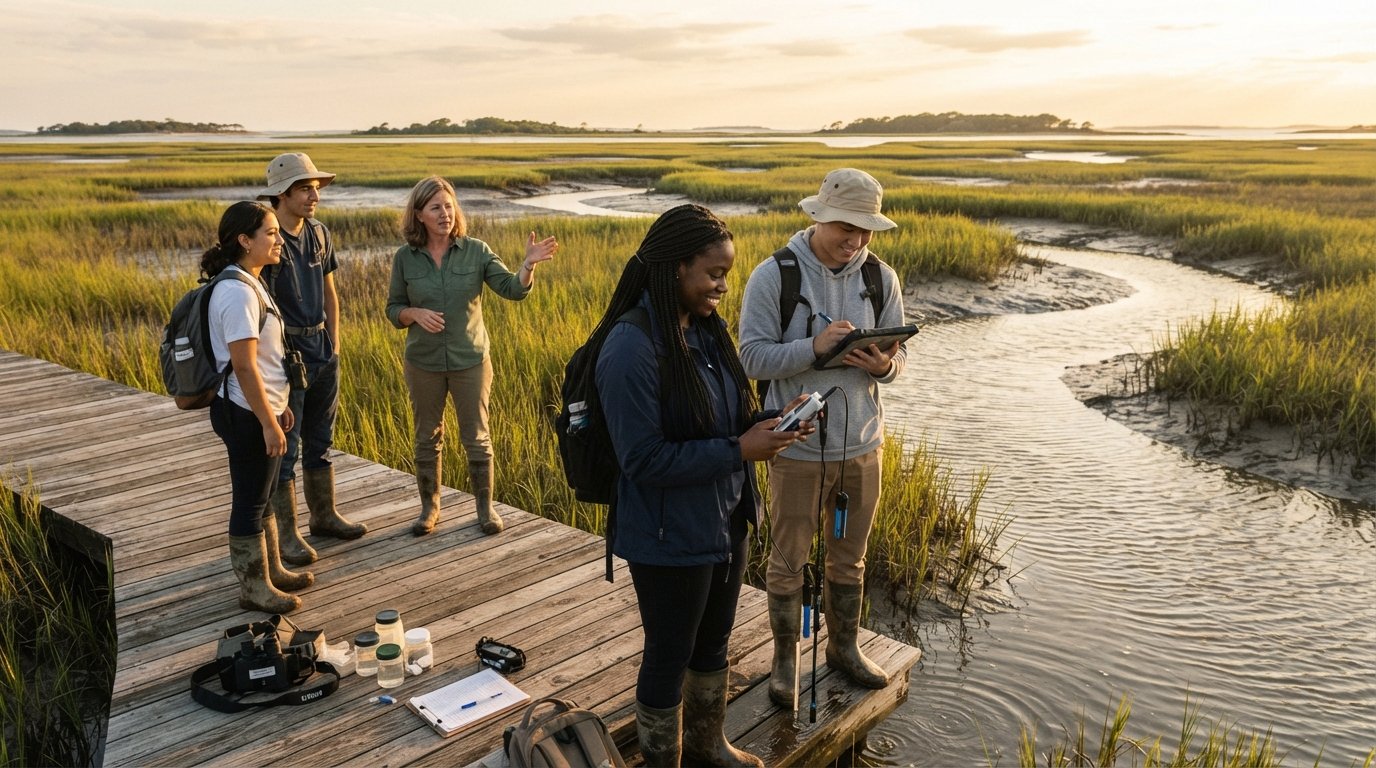
One of the strongest features of the program is its location. CCGA sits in Brunswick, Georgia, near the coast, and faculty frequently incorporate field experiences into courses. Students may find themselves sampling water quality in a tidal creek, surveying marsh vegetation, or analyzing coastal erosion data. That kind of applied learning is difficult to replicate in a purely online program, and it gives graduates a portfolio of real-world experience to discuss in interviews and on applications to graduate school.
The program also emphasizes transferable skills: data analysis, scientific writing, and problem solving. These are the competencies that hiring managers in environmental consulting firms, state agencies, and nonprofits consistently rank as most important. If you are considering a career in environmental science, you can explore related online programs and funding options through Scholarship.Education to compare pathways and costs before you commit.
How the In-Person and Online Mix Works
CCGA's Environmental Science degree is delivered through a mix of in-person and online courses, which gives students flexibility without sacrificing the hands-on components that make the degree valuable. In practice, this means that some lecture-based courses, particularly general education requirements and introductory science courses, may be available online, while laboratory courses, field courses, and upper-level seminars are typically delivered in person. The exact mix can vary by semester and by course, so prospective students should check the current course schedule and speak with an academic advisor before planning their sequence.
This hybrid structure is especially helpful for students who commute, work part-time, or have family responsibilities. Online courses can reduce the number of trips to campus each week, while in-person labs and field work ensure that students still gain the practical experience employers expect. It also allows students to catch up or get ahead during summer terms, which can shorten the time to graduation or lighten the load during the regular academic year.
For students who want to maximize online learning, it is worth asking advisors which courses are routinely offered online and which are not. Some programs also offer hybrid courses that meet in person only a few times per semester, with the rest of the instruction delivered online. Understanding these details early can help you build a schedule that fits your life.
Admission Requirements and Application Steps
Admission to CCGA is generally accessible to students who meet the institution's standard requirements, and the Environmental Science program does not typically require a separate, competitive application beyond admission to the college. That said, strong preparation in high school science and math courses will help you succeed in the major. Prospective students should plan to submit an application, official high school transcripts or GED scores, and standardized test scores if required. Transfer students should be prepared to submit transcripts from all previously attended institutions.
Here is a practical sequence for applying:
- Complete the college application and pay any required fee or request a fee waiver.
- Submit official transcripts from your high school and any colleges you have attended.
- Submit ACT or SAT scores if the admissions office requires them for your application type.
- Apply for financial aid by completing the FAFSA, and check the college's priority deadline.
- Meet with an academic advisor to map out your first-semester courses and confirm which are available online.
After admission, students should register for orientation and meet with an advisor as early as possible. Advisors can help you understand the sequence of science courses, which often have prerequisites, and can flag which courses are offered online versus in person. This planning step is easy to overlook, but it can save you a semester or more if you avoid taking courses out of order.
Costs, Financial Aid, and Funding Strategies
Cost is one of the biggest factors in choosing a college, and CCGA's in-state tuition is generally more affordable than many four-year universities, especially for Georgia residents. Still, students should budget for tuition, fees, books, lab supplies, transportation, and living expenses. The hybrid format can help reduce some costs, such as commuting and parking, but it does not eliminate tuition and fees. Students should also account for any technology needs, such as a reliable laptop and internet access, which are essential for online coursework.
Financial aid options for Environmental Science majors include federal student aid, state grants, institutional scholarships, and private scholarships. The FAFSA is the starting point for most aid, and students should complete it every year they are enrolled. Georgia residents may also qualify for state scholarship and grant programs, and CCGA offers its own scholarships that students can apply for through the college. It is worth checking with the financial aid office about work-study positions, which can provide income and relevant experience.
Students who are exploring online college options should also review guides on how to find grants for online college students, since some grants and scholarships are specifically available to students taking online or hybrid courses. Combining federal aid, state grants, institutional scholarships, and private awards is often the most effective way to reduce out-of-pocket costs. Students and families who want a broader overview of college costs and financial planning can consult resources like CollegeAndTuition, which covers tuition trends, aid strategies, and college planning tools.
Careers and Internships for Environmental Science Graduates
Environmental Science graduates from CCGA pursue a range of careers, and the coastal location opens doors to internships with agencies and organizations that work on water quality, coastal management, and conservation. Typical employers include state and federal environmental agencies, local governments, environmental consulting firms, nonprofits, and industries that need environmental compliance staff. Graduates may work as environmental scientists, conservation technicians, GIS analysts, environmental educators, or policy analysts, among other roles.
Internships are a key part of the career pathway, and students should start looking for opportunities by their junior year. Faculty members often have connections with local agencies and organizations, and the college's career services office can help with resumes, interview preparation, and job searches. Students who plan to attend graduate school should talk with faculty about research opportunities and build relationships that can lead to strong letters of recommendation.
Because the program blends online and in-person learning, students can also use online courses to free up time for internships or part-time work during the semester. That flexibility is a practical advantage that can make the difference between graduating with relevant experience and graduating without it.
Is CCGA's Environmental Science Program Right for You?
Choosing a college is a personal decision, and the right fit depends on your goals, your budget, and your learning style. CCGA's Environmental Science Bachelor's degree is a strong option for students who want a science-focused education with hands-on field experience and the flexibility of online coursework. It is especially appealing for Georgia residents, students who want to stay near the coast, and students who need to balance school with work or family commitments.
Prospective students should visit campus if possible, meet with faculty, and ask detailed questions about course availability, lab requirements, and internship support. It is also worth comparing CCGA with other programs on cost, class size, and career outcomes. Students who want to explore a wider range of online and hybrid programs can use Scholarship.Education's program search tools to compare options and request information from schools.
For students who are ready to take the next step, the process is straightforward: apply, complete the FAFSA, meet with an advisor, and plan your course sequence. With careful planning and a clear understanding of the in-person and online mix, the Environmental Science degree at College of Coastal Georgia can be a practical and affordable path to a career in environmental science.