
Welding Associate's Degree: 2-Year ACC Program Guide
Explore the Welding Technology/Welder Associate's degree, usually 2 years In-person at Austin Community College District, and how to fund this hands-on trade path.

By Isaac Griffin
Skilled welders build the ships, pipelines, bridges, and buildings that keep the modern economy moving, and demand for trained professionals remains strong across Texas and the nation. If you are weighing a fast path into a hands-on, well-paying trade, the Welding Technology/Welder Associate's degree, usually 2 years In-person at Austin Community College District, offers one of the most direct routes from the classroom to the job site. This guide explains what the program covers, how to get in, what it costs, and how to pay for it, so you can decide whether this credential fits your career plans.
Austin Community College (ACC) sits at the center of one of the fastest-growing metro areas in the United States, and construction, manufacturing, and energy employers in Central Texas regularly hire graduates from its welding program. Because the training is in-person and lab intensive, students build real muscle memory with torches, electrodes, and metal, not just theory from a textbook. That hands-on reality is exactly what employers say they want.
What the Welding Technology/Welder Associate's Degree Covers
The Welding Technology/Welder Associate of Applied Science degree at Austin Community College is designed as a workforce credential, not a transfer degree. That means the coursework leans heavily toward applied skills and industry standards rather than liberal arts electives. Students learn to read blueprints, interpret welding symbols, set up and operate multiple welding processes, and inspect their own work for quality and safety.
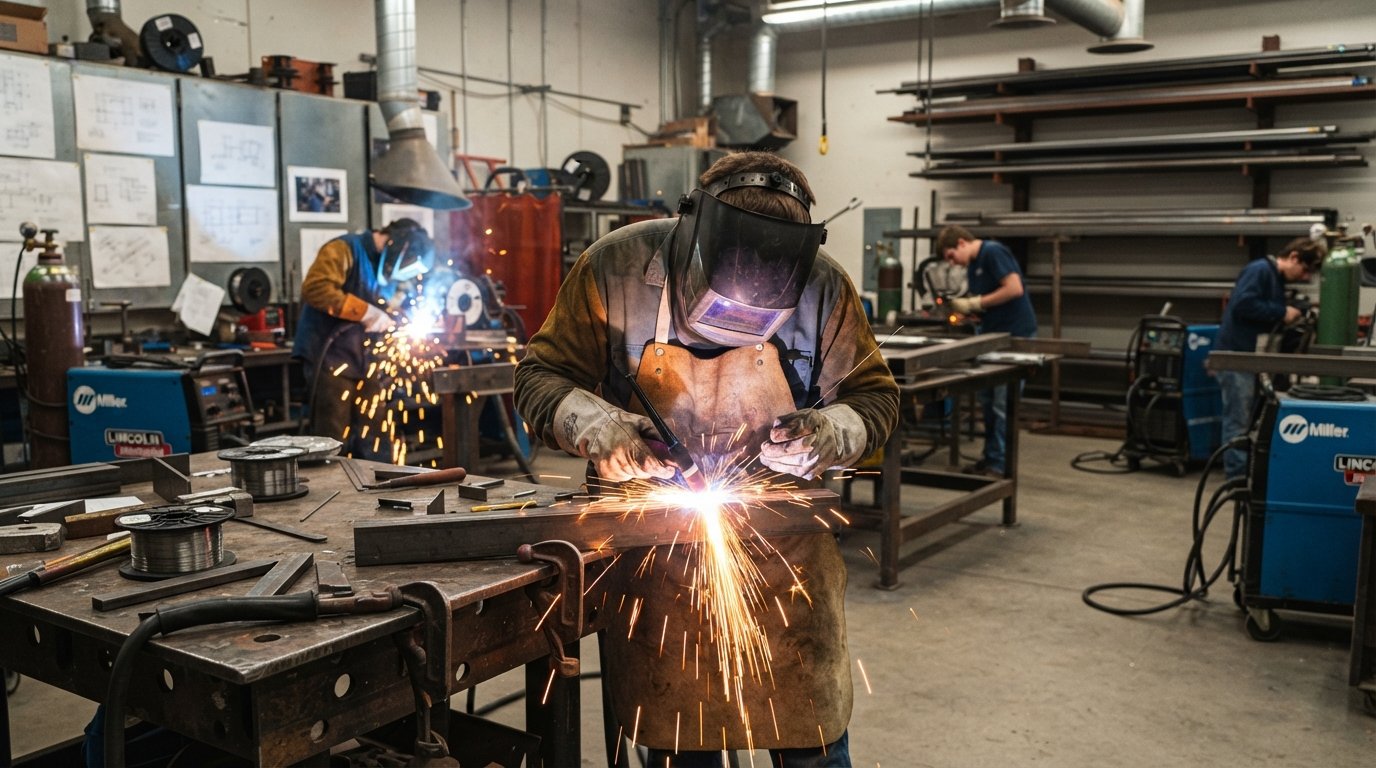
ACC's welding program is known for training students across several processes, including shielded metal arc welding (stick), gas metal arc welding (MIG), flux cored arc welding, and gas tungsten arc welding (TIG). Students also study cutting processes, joint preparation, metallurgy basics, and fabrication. Coursework typically blends lecture with substantial shop time, and students are expected to produce weld samples that meet visual and destructive testing standards.
Beyond the torch, the degree includes general education courses in communication, mathematics, and workplace skills. Those classes matter more than they might seem: welding supervisors and inspectors often need to document procedures, communicate with engineers, and follow safety codes, and employers value workers who can do all three. The full degree usually takes about two years of full-time study, though part-time students may stretch it longer depending on course availability.
Core Skills You Will Build
The curriculum is built around competencies that map directly to entry-level welding jobs and apprenticeships. Expect to spend significant time on the following:
- Blueprint reading and welding symbol interpretation for fabrication work
- Setup, operation, and troubleshooting of SMAW, GMAW, FCAW, and GTAW equipment
- Joint preparation, fit-up, and distortion control on carbon steel and other metals
- Visual inspection, destructive testing, and weld quality documentation
- Shop safety, personal protective equipment, and OSHA-aligned work practices
Each of these skills shows up in job postings for welders, combination welders, and fabrication technicians. Students who master them and build a portfolio of test welds often have a leg up when applying for positions that require certification tests, because they have already practiced under supervised conditions.
Admission Requirements and How to Apply
ACC maintains an open-door admission policy for the college overall, but welding programs often have additional steps because lab seats are limited and safety training is mandatory. Prospective students typically apply to the college, submit transcripts or proof of readiness for college-level coursework, and complete any required placement measures. Because this is an in-person program, students should also plan for campus visits, orientation, and scheduling that fits lab hours.
It helps to treat the application like a small project with a timeline. Most students fare best when they complete general admission steps early, meet with an academic advisor or program coordinator, and register for classes as soon as registration opens. Welding labs fill quickly, and popular sections may have waitlists.
- Apply to Austin Community College and activate your student account.
- Submit required documents, including transcripts and any placement or readiness information.
- Meet with an advisor to confirm program requirements and map your first semester.
- Register for classes during your assigned registration window and secure lab sections early.
- Attend orientation and complete any safety training before the first lab meeting.
Students who are still exploring options may want to compare this program with other two-year allied health and trades pathways. For example, some learners weigh welding against healthcare training, and resources such as this guide to online associate degree in nursing options can help clarify how program formats and costs differ across fields.
Costs, Financial Aid, and Funding Options
Tuition at a public community college is generally far lower than at a four-year university, but welding programs carry additional costs for consumables, personal protective equipment, and tools. Students should budget for tuition and fees, a welding helmet, gloves, jacket, boots, and possibly a basic tool kit. Some programs provide shared equipment, but personal protective gear is usually the student's responsibility.
Financial aid is available to eligible students through federal and state programs, and the FAFSA is the starting point for most of it. The Welding Technology/Welder Associate's degree, usually 2 years In-person at Austin Community College District, qualifies for federal student aid for students who meet eligibility requirements, and ACC's financial aid office can help students understand grants, work-study, and loan options. Scholarships from trade associations, local employers, and workforce development programs can further reduce out-of-pocket costs.
Prospective students should also research workforce grants and employer sponsorship programs. Some Central Texas employers pay for part or all of an employee's welding training in exchange for a commitment to work for them after graduation. These arrangements can turn a two-year degree into a nearly debt-free path into a career. Families comparing costs across institutions may find broader planning resources helpful, including tools and guides like CollegeAndTuition, which covers college affordability and financial aid planning in the United States.
Career Outcomes and Earning Potential
Welders work in fabrication shops, construction sites, manufacturing plants, pipeline operations, shipyards, and maintenance departments. The Bureau of Labor Statistics groups welding under welders, cutters, solderers, and brazers, and median pay in that category has historically been solid for workers with formal training and certifications. Pay varies widely by industry, location, and skill level: pipeline and aerospace welding tend to pay more, while entry-level shop work pays less but offers steady hours and a path to advancement.
Graduates of associate-level welding programs often start as welders, fitter helpers, or fabrication assistants, then move into combination welding roles, lead positions, inspection, or shop supervision. Some welders pursue additional certifications, such as AWS credentials, to qualify for higher-paying work. Others use the degree as a foundation for careers in welding engineering technology, quality assurance, or sales of welding equipment and consumables.
It is important to be realistic: welding is physically demanding, and work environments can be hot, loud, and dirty. But for people who enjoy building things with their hands and seeing tangible results at the end of the day, it can be a rewarding and stable career. The degree also signals to employers that a candidate has completed formal safety training and can follow procedures, which matters in industries with strict quality standards.
Why Choose ACC for Welding Training
Austin Community College has several advantages for welding students. Its location in the Austin metro gives students access to a large employer base, and the college maintains relationships with local industry through advisory committees and workforce partnerships. Lab facilities are equipped for multiple processes, so students can practice the techniques employers actually use.
ACC also offers support services that matter for working adults and first-generation students, including academic advising, tutoring, and career services. Because the program is in-person, students get direct feedback from instructors who have worked in the field, and they build relationships with classmates who can become professional contacts later. For many students, that combination of affordable tuition, local industry ties, and hands-on instruction is exactly what they need to launch a trade career without taking on heavy debt.
How to Decide If This Program Is Right for You
Choosing a welding program is a personal decision, and it helps to ask a few practical questions before enrolling. Do you prefer a structured, in-person schedule with lab time? Are you prepared for the physical demands of shop work? Do you want to enter the workforce after two years, or do you plan to continue toward a bachelor's degree later? Answering these questions honestly will clarify whether an associate degree in welding is the right fit.
Students who want flexibility might explore online options in other fields, but welding is a trade that requires hands-on practice, so in-person training is generally the right choice for this career path. It is also worth visiting campus, talking with instructors, and reviewing course syllabi to understand the time commitment. A short conversation with an advisor can prevent costly scheduling mistakes later.
Finally, keep funding in mind from day one. Completing the FAFSA, applying for local scholarships, and talking with employers about sponsorship can dramatically change the affordability picture. The Welding Technology/Welder Associate's degree, usually 2 years In-person at Austin Community College District, is an investment in a skill set that travels well: welders are needed in nearly every industry, and a solid training program opens doors to jobs that cannot be outsourced or automated easily.
If you are ready to trade a classroom-only education for a career where you can see your work take shape, ACC's welding program deserves a serious look. Start by checking admission deadlines, scheduling a campus visit, and filing your financial aid paperwork early so you can focus on what matters most: learning to weld well.