
Soccer Skills Training With a Sports Scholarship Pathway
Soccer skills training with a sports scholarship pathway works best when training, recruiting exposure, and academic eligibility move together. Here is the full plan.

By Julian Walsh
Every year, thousands of talented soccer players wonder why their club performances never translate into college offers. The answer is rarely a lack of talent. It is almost always a lack of structure. Soccer skills training with a sports scholarship pathway is not about training harder, it is about training with a destination in mind. When technical development, physical benchmarks, and recruiting exposure move in the same direction, a player stops hoping for a scholarship and starts building one. This guide breaks down the full pathway: how recruiting timelines work, what coaches actually measure, how to build a highlight reel that gets watched, which academic requirements run parallel to athletic training, and what a soccer scholarship may not cover so families can plan honestly for the costs that remain.
How College Soccer Recruiting Timelines Actually Work
Recruiting does not begin when a player decides it should. It begins when a coach first notices a name, and that can happen earlier than most families expect. In the United States, meaningful contact between college coaches and prospects typically accelerates during sophomore and junior year of high school, with serious roster conversations and offers often forming in that window. Top division programs may identify talent even earlier, but the evaluation period that matters most for the majority of families runs from the start of ninth grade through the summer before senior year.
This timeline has a direct consequence for training design. A player who starts structured, goal-oriented training in ninth grade has roughly three full years to build a measurable profile before recruiting pressure peaks. A player who starts in junior year is not out of the running, but the pathway compresses, and the emphasis shifts toward rapid exposure through showcases, tournaments, and direct coach outreach. The key insight for families is that soccer skills training with a sports scholarship pathway should begin before the recruiting calendar demands it, not in response to it.
The recruiting calendar itself has phases worth understanding. Quiet periods, contact periods, and dead periods govern when coaches can communicate with prospects, and these rules differ by division. Rather than memorizing every date, players should align their training cycle with the exposure calendar: build skills in the off-season, peak athletically before major showcases, and use the quieter windows for academic work and profile maintenance. Families who treat training and recruiting as one continuous calendar, rather than two separate projects, consistently get better results.
It also helps to understand how coaches build a roster. A college coach is not simply collecting the most skilled players available. Coaches are assembling a team with positional needs, graduation gaps, and style-of-play fit in mind. That means a player who is an outstanding winger may be overlooked at a program stacked with wingers but heavily recruited by a program losing two seniors in that position. Researching rosters, graduation years, and playing styles at target schools is part of the training pathway because it tells a player which skills to sharpen and which programs to approach.
Which Skills and Measurable Benchmarks Recruiters Actually Evaluate
Recruiters evaluate two broad categories: what they see with their eyes and what they can verify with numbers. The eye test covers first touch, decision speed, off-ball movement, defensive work rate, and composure under pressure. These qualities are difficult to quantify, which is why live and video evaluation remains central to recruiting. The numbers cover speed, endurance, strength, and technical consistency, and they give coaches a way to compare players across different leagues and regions.
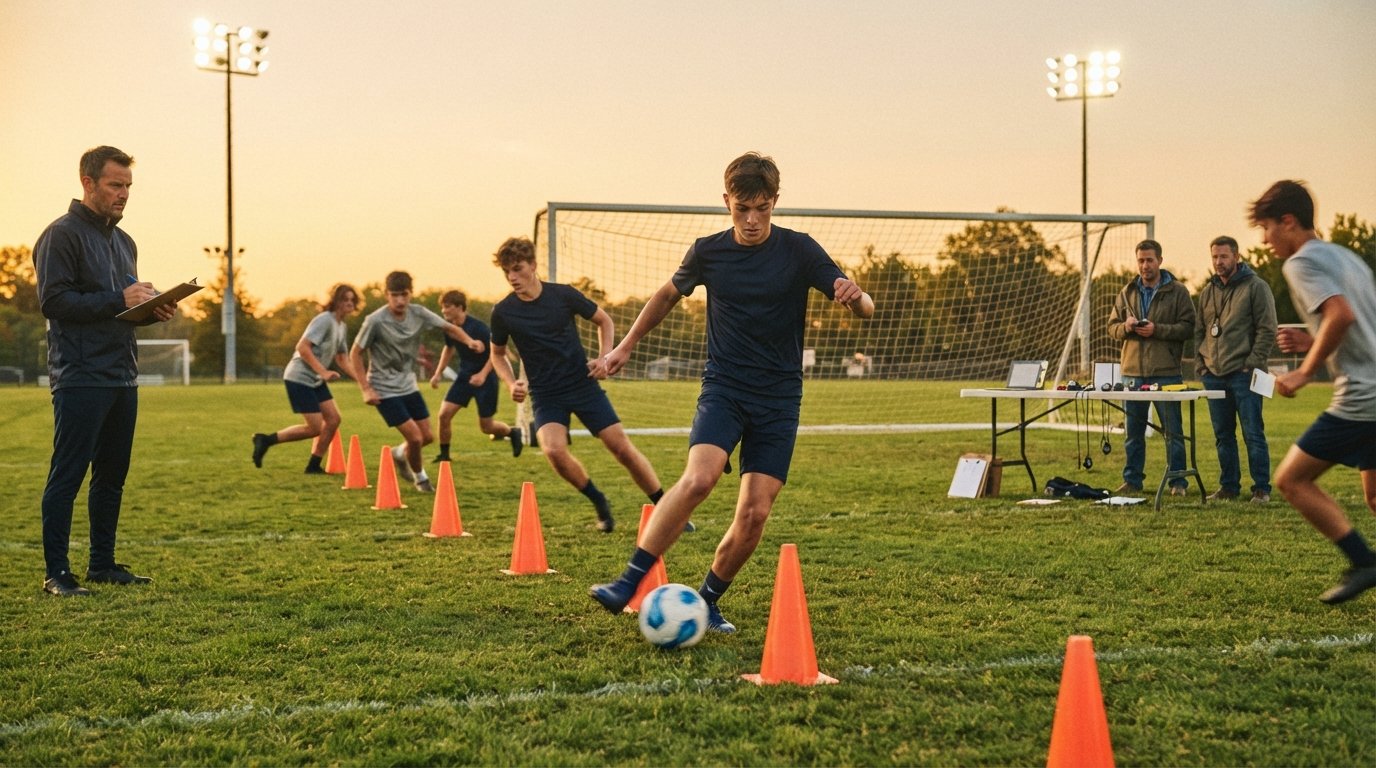
Players who want to stand out should train both categories deliberately. Technical sessions build the eye-test qualities, while testing days and fitness benchmarks build the verifiable profile. The most effective soccer skills training with a sports scholarship pathway combines both in a weekly rhythm rather than treating them as separate seasons. A sample weekly structure for a committed high school player might look like this:
- Two technical sessions focused on first touch, passing under pressure, and finishing with both feet
- One speed and agility session with timed sprints and change-of-direction work
- One strength and injury-prevention session emphasizing hamstrings, hips, and core stability
- One tactical session or small-sided game to develop scanning, positioning, and decision speed
- One recovery day with mobility work and light ball mastery
Benchmarks give this work a scoreboard. Common measurements coaches look for include sprint times over ten, twenty, and forty meters, vertical jump, agility test results, and endurance indicators such as the Yo-Yo test. Technical consistency can be tracked through repetition counts: passes completed under pressure, finishing conversion rates in small-sided drills, and first-touch retention in tight spaces. Players should test themselves every eight to twelve weeks and record the results. A rising trend line in verified numbers is one of the most persuasive things a recruiting profile can show.
Position-specific skills deserve special attention because coaches recruit positions, not generic players. Goalkeepers need distribution, shot-stopping, and command of the box. Center backs need aerial strength, reading of the game, and clean progression passing. Midfielders need scanning habits, press resistance, and engine capacity. Forwards need movement in the box, finishing variety, and pressing intensity. A player who builds a training plan around the demands of one or two target positions will develop a clearer, more recruitable identity than a generalist who is decent everywhere and exceptional nowhere.
Building a Highlight Reel and Recruiting Profile That Gets Watched
College coaches receive enormous volumes of outreach and video. Most clips are watched for less than a minute before a decision is made. That reality should shape everything about a player's recruiting materials. A highlight reel is not a season recap, it is a targeted argument for why a coach should keep watching. The best reels open with the player's best three moments in the first thirty seconds, show game footage rather than drills, and include a title card with name, graduation year, position, contact details, and key measurements.
Length matters. A main reel of two to four minutes is standard, with shorter position-specific clips available on request. Footage should be recent, ideally from the past twelve months, and shot from an elevated angle that shows positioning and decision-making, not just ball touches. Coaches want to see what a player does without the ball: scanning, runs, defensive recovery, and communication. Including a few clips of mistakes followed by recoveries can actually help, because it shows resilience and game intelligence.
The recruiting profile is the written companion to the reel. It should include academic information (grade point average, test scores if available, intended major), athletic information (position, dominant foot, height, weight, verified test results, club and team history, honors), and a short personal statement that conveys character and coachability. A simple one-page profile in PDF format, updated each season, is more useful than an elaborate website. Consistency across the reel, profile, and outreach emails builds trust, and trust is what turns a viewed video into a conversation.
Exposure is the final piece. Highlight reels do not recruit on their own; they support conversations that begin elsewhere. Showcases, regional tournaments, club league playoffs, and ID camps are the venues where coaches see players live. Players should choose events strategically, targeting tournaments where their realistic list of schools will have coaches present. Sending a short, personalized email to a coach before an event, referencing the event, the player's schedule, and a specific reason for interest in that program, dramatically increases the odds of being watched. Follow-up after the event should be brief and include the updated reel link. To understand the broader mechanics of how offers and eligibility fit together, see this guide on how sports scholarships work for college athletes.
Academic Eligibility Requirements That Run Alongside Athletic Training
A strong soccer skills training with a sports scholarship pathway plan is only half the equation. The other half is the transcript. College athletic eligibility in the United States is governed by rules that require specific core courses, a minimum grade point average, and, where applicable, standardized test scores. These requirements are not optional and cannot be waived by a coach who wants a player. A coach may love a player's film and still be unable to offer a roster spot if eligibility is not met.
Families should treat academic planning as part of the training calendar. Course selection in ninth and tenth grade determines whether a player will have the required core credits by senior year. A player who discovers a missing math or science credit in junior year faces a scramble that can cost a season. Regular check-ins with a school counselor, ideally once per semester, keep the academic side on track without drama. For players aiming at higher divisions, the academic bar is often higher, and stronger grades open doors to better programs and larger scholarship packages.
International players face additional layers. Language proficiency tests, credential evaluations, and visa timelines all take months, and they must be sequenced around recruiting outreach. Players from the UK, Canada, Australia, and the EU should start eligibility research at least eighteen months before their intended enrollment date. The same principle applies to families exploring alternative degree routes: academic planning is inseparable from athletic opportunity. Students who want to compare traditional and online pathways can explore degree options through CollegeDegree.Education, which connects prospective students with accredited colleges and programs, while keeping eligibility requirements in view.
Funding Gaps: What a Soccer Scholarship May Not Cover
One of the most common misconceptions in youth soccer is that a scholarship means a free education. In reality, soccer scholarships are often partial, and the total cost of attendance includes many line items that athletic awards may not touch. Understanding these gaps early allows families to plan, apply for additional aid, and avoid unpleasant surprises in the spring of senior year.
Typical gaps include tuition beyond the athletic award, room and board, books and supplies, mandatory fees, health insurance, travel to and from campus, and personal expenses. Some programs cover portions of these costs through combined aid packages, but the athletic scholarship alone rarely covers everything. Additionally, many divisions do not offer athletic scholarships at all, though academic merit aid and need-based aid may still be available. Families should also note that scholarships are typically renewed annually and may carry performance or conduct conditions.
The practical response is to build a funding plan alongside the training plan. This means filing the FAFSA, researching academic scholarships, applying for outside awards, and understanding how athletic and academic aid can be combined. Players with strong grades often qualify for institutional merit awards that close the gap left by a partial athletic scholarship. For families comparing offers, the right question is not which scholarship is largest, but which total package leaves the lowest out-of-pocket cost. Many students also explore online degree programs as a flexible, lower-cost route to a degree while continuing to compete, and Scholarship.Education maintains resources on scholarships, financial aid, and online program options to support that comparison.
It is also worth planning for the possibility of injury or a change in athletic trajectory. A player who loses a season to injury may find a scholarship offer reduced or restructured. Academic strength provides a safety net, because merit aid and admission offers do not disappear when an athletic season does. The most resilient pathways are those where the player is recruitable as an athlete and admissible as a student, giving families two independent reasons for the school to say yes.
Putting the Pathway Together
A soccer scholarship is not won in a single showcase or a single season. It is built through a deliberate sequence: structured skills training that produces measurable improvement, a recruiting calendar that guides exposure, a highlight reel and profile that make evaluation easy, academic eligibility that clears the institutional bar, and a funding plan that accounts for the gaps a partial award leaves behind. Players who treat these elements as one integrated project, rather than five separate chores, consistently find that opportunities appear where they once seemed unlikely.
The most important step is starting early and staying consistent. A player who trains with purpose in ninth grade, tests and records benchmarks every few months, updates a reel each season, and keeps grades strong will enter the recruiting window with options. A player who waits until junior year can still succeed, but the margin for error shrinks. Either way, the pathway is available to anyone willing to build it with discipline, honesty, and a clear plan.
Disclosure: Scholarship.Education receives compensation from listed schools through advertising, links, and search placement, which may influence their appearance, position, and ranking. This content is for general reference only and is not legal, academic, or career advice.