
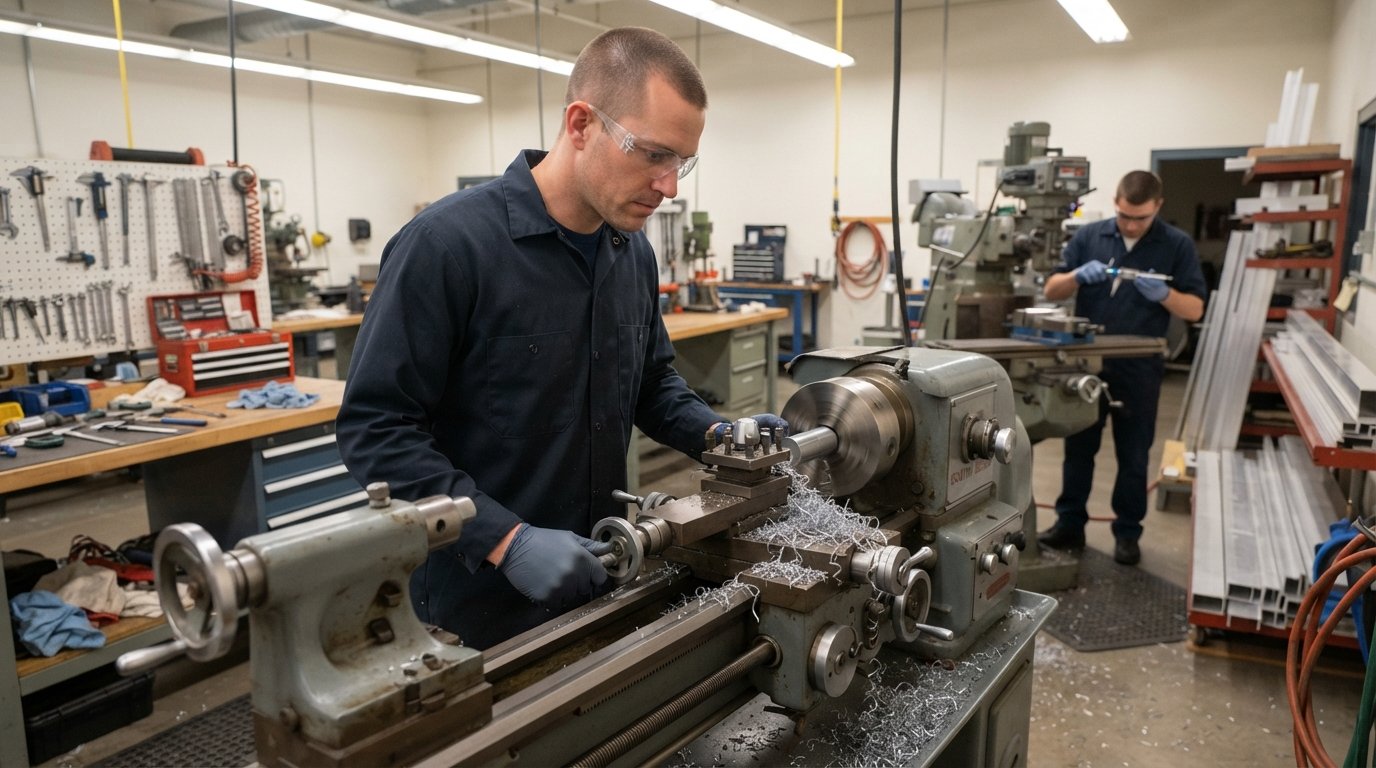
Machine Shop Technology Certificate at Blue Ridge CC
The Machine Shop Technology/Assistant Certificate at Blue Ridge Community College prepares you for a machinist career in under two years with hands-on training.

By James Miller
Skilled machinists are the backbone of modern manufacturing, turning raw metal into precision components that power everything from medical devices to aerospace systems. If you have ever considered a hands-on career where your work matters and your skills are in constant demand, the Machine Shop Technology/Assistant Certificate, 1 year to less than 2 years In-person at Blue Ridge Community College offers a fast, affordable pathway into this essential trade. In roughly 12 to 18 months, you can move from curious beginner to job-ready technician, learning on real machines with real tools under instructors who know the industry firsthand.
Blue Ridge Community College, located in the Shenandoah Valley region of Virginia, has built a reputation for delivering career-focused training that employers actually value. The machine shop program is no exception. It blends classroom instruction with extensive hands-on shop time, ensuring graduates leave with the confidence and competence to pass entry-level machining tests and contribute on day one. For students who want to avoid four years of tuition debt while still landing a stable, well-paying job, this certificate is a compelling option.
Why Choose a Machine Shop Technology Certificate
The manufacturing sector in the United States faces a well-documented skills gap. As experienced machinists retire, companies struggle to find workers who can set up and operate lathes, milling machines, and computer numerical control (CNC) equipment. This gap translates into opportunity for anyone willing to learn the trade. A certificate program signals to employers that you have completed structured training and are ready to work.
Unlike a full associate degree, a certificate program focuses exclusively on the core skills you need to get hired. You will not spend semesters on general education courses that do not directly relate to machining. Instead, every class builds toward your ability to read blueprints, measure with precision, select tooling, and produce parts that meet tight tolerances. This efficiency means you enter the workforce sooner and start earning sooner.
Cost is another major advantage. Community college tuition is a fraction of what private technical schools or four-year universities charge. Many students complete the certificate with minimal debt, especially when they take advantage of financial aid, scholarships, or employer tuition assistance. For adults considering a career change or high school graduates who want a practical path, the return on investment is attractive.
Finally, the hands-on nature of the training suits people who learn best by doing. If you enjoy working with your hands, solving spatial problems, and seeing tangible results from your efforts, machine shop technology can be deeply satisfying. The work is precise, challenging, and varied, with opportunities to specialize in areas like CNC programming, tool and die making, or quality inspection.
Program Format and What to Expect
The Machine Shop Technology/Assistant Certificate, 1 year to less than 2 years In-person at Blue Ridge Community College is designed for full-time students who can attend daytime classes, though part-time options may be available depending on scheduling. The in-person format is intentional: machining is a tactile skill, and you cannot learn to feel the vibration of a cutting tool or judge the finish on a part through a screen. Being in the shop, with access to the same equipment used in industry, accelerates your learning curve dramatically.
Classes typically cover a progression of topics, starting with shop safety and basic measurement, then moving into manual machine operations, and finally advancing to CNC programming and setup. You will spend significant time at the lathe and milling machine, learning to turn, face, drill, bore, and thread metal to exact specifications. Blueprint reading and geometric dimensioning and tolerancing (GD&T) are woven throughout, because a machinist who cannot interpret a drawing is of little use on the shop floor.
Instructors at Blue Ridge Community College bring real-world experience to the classroom. Many have worked in production shops, tool rooms, or maintenance departments, and they understand what employers expect. They will not just show you how to make a part; they will explain why certain speeds and feeds work, how to troubleshoot when something goes wrong, and how to work efficiently without sacrificing quality. This mentorship is one of the hidden benefits of a smaller program.
Assessment is typically based on a combination of written tests, practical projects, and participation. You will build a portfolio of parts that demonstrates your skills, which can be invaluable when interviewing for jobs. Some programs also prepare students for industry-recognized credentials, such as National Institute for Metalworking Skills (NIMS) certifications, which add credibility to your resume.
Core Skills You Will Learn
The curriculum is built around the competencies that employers consistently demand. While specific course titles may vary, the following skills form the foundation of the certificate:
- Manual machining: Operating lathes, milling machines, drill presses, and grinders to produce parts to print specifications.
- Blueprint reading and GD&T: Interpreting engineering drawings, symbols, and tolerances accurately.
- Precision measurement: Using calipers, micrometers, height gauges, and other instruments to verify dimensions within thousandths of an inch.
- CNC setup and operation: Writing and editing basic G-code, setting tool offsets, and running CNC mills and lathes.
- Shop safety and maintenance: Following safe work practices and performing routine machine maintenance.
These skills are not taught in isolation. A typical project might require you to read a blueprint, plan a sequence of operations, select and set up tooling, machine the part, measure it, and then adjust your process to correct any deviation. This integrated approach mirrors the way work actually happens in a machine shop, where problem-solving and adaptability are just as important as technical knowledge.
Beyond the technical skills, you will also develop soft skills that employers value: communication, teamwork, attention to detail, and the ability to work under deadline pressure. Machinists often collaborate with engineers, quality inspectors, and other tradespeople, so being able to explain a problem clearly and ask for help when needed is essential.
Admission Requirements and How to Apply
Admission to the machine shop certificate program at Blue Ridge Community College is generally straightforward. Most community colleges require a high school diploma or equivalent, such as a GED. You may also need to take placement tests in math and reading to ensure you are ready for college-level coursework. If your skills need refreshing, developmental courses are available to get you up to speed.
The application process typically involves completing the college application, submitting transcripts, and meeting with an academic advisor. The advisor will help you map out your course sequence, discuss financial aid options, and answer any questions about the program. Because the program is in-person and may have limited seats, it is wise to apply early, especially if you are targeting a fall start.
Financial aid is a major consideration for many students. The Free Application for Federal Student Aid (FAFSA) is the starting point for grants, work-study, and federal loans. Blue Ridge Community College also offers institutional scholarships and may have partnerships with local employers who sponsor training. If you are a veteran or military family member, you may be eligible for education benefits that cover tuition and fees. For a broader overview of funding options, see this guide to community college grants and financial aid options.
Career Outcomes and Job Outlook
Graduates of the Machine Shop Technology/Assistant Certificate, 1 year to less than 2 years In-person at Blue Ridge Community College are prepared for entry-level positions such as machine operator, CNC operator, or machinist assistant. With experience, they can advance to setup technician, CNC programmer, tool and die maker, or quality control inspector. Some machinists eventually move into supervisory roles or start their own shops.
The job outlook for machinists and tool and die makers is stable, with demand driven by manufacturing activity in sectors like aerospace, automotive, medical devices, and defense. According to the U.S. Bureau of Labor Statistics, machinists earned a median annual wage of around $50,000 in recent years, with experienced CNC programmers and toolmakers earning considerably more. Wages vary by region, industry, and skill level, but the career offers a solid middle-class income without requiring a four-year degree.
One of the advantages of this trade is its portability. Machining skills are in demand across the country and even internationally. If you are willing to relocate or work different shifts, you can find opportunities in almost any manufacturing hub. Many employers also offer overtime and shift differentials, which can boost your earnings significantly.
Paying for Your Certificate
Cost should never be a barrier to career training, and there are multiple ways to fund your education. Start by completing the FAFSA to determine your eligibility for federal Pell Grants, which do not need to be repaid. Virginia residents may also qualify for state grant programs. Blue Ridge Community College likely offers payment plans and may have emergency funds for students facing unexpected expenses.
Scholarships are another valuable resource. Local manufacturers, community organizations, and trade associations often award scholarships to students pursuing skilled trades. These awards can cover tuition, books, and tools. It is worth spending time searching for scholarships specific to manufacturing and machining, as competition may be lower than for general academic awards.
If you are already employed, ask your employer about tuition reimbursement or apprenticeship programs. Many companies invest in their workers' skills because they need machinists and want to retain talent. Even if your current job is not in manufacturing, some employers offer educational benefits that can be applied to any field of study.
For students exploring broader higher education pathways, resources like CollegeDegrees.School provide guidance on degree options, career planning, and financial aid, helping you make informed decisions about your future.
Is This Program Right for You?
The Machine Shop Technology/Assistant Certificate, 1 year to less than 2 years In-person at Blue Ridge Community College is an excellent fit for people who enjoy working with their hands, have an eye for detail, and want to enter a stable trade without spending years in school. It is also a strong option for career changers who need to retool quickly and for veterans transitioning to civilian employment.
If you are unsure whether machining is for you, consider visiting the campus and touring the shop. Talk to instructors and current students. Ask about job placement rates and which local employers hire graduates. This firsthand research will give you a realistic sense of what the program entails and where it can lead.
Manufacturing is evolving, with automation and advanced technologies changing the way parts are made. But the need for skilled machinists who can think critically, solve problems, and produce quality work remains constant. A certificate from Blue Ridge Community College can be your entry point into a rewarding career that offers job security, competitive pay, and the satisfaction of building things that matter.
Take the next step today by contacting the admissions office, completing your FAFSA, and exploring scholarship opportunities. Your future in machining starts with a single decision, and the skills you gain will serve you for a lifetime.