
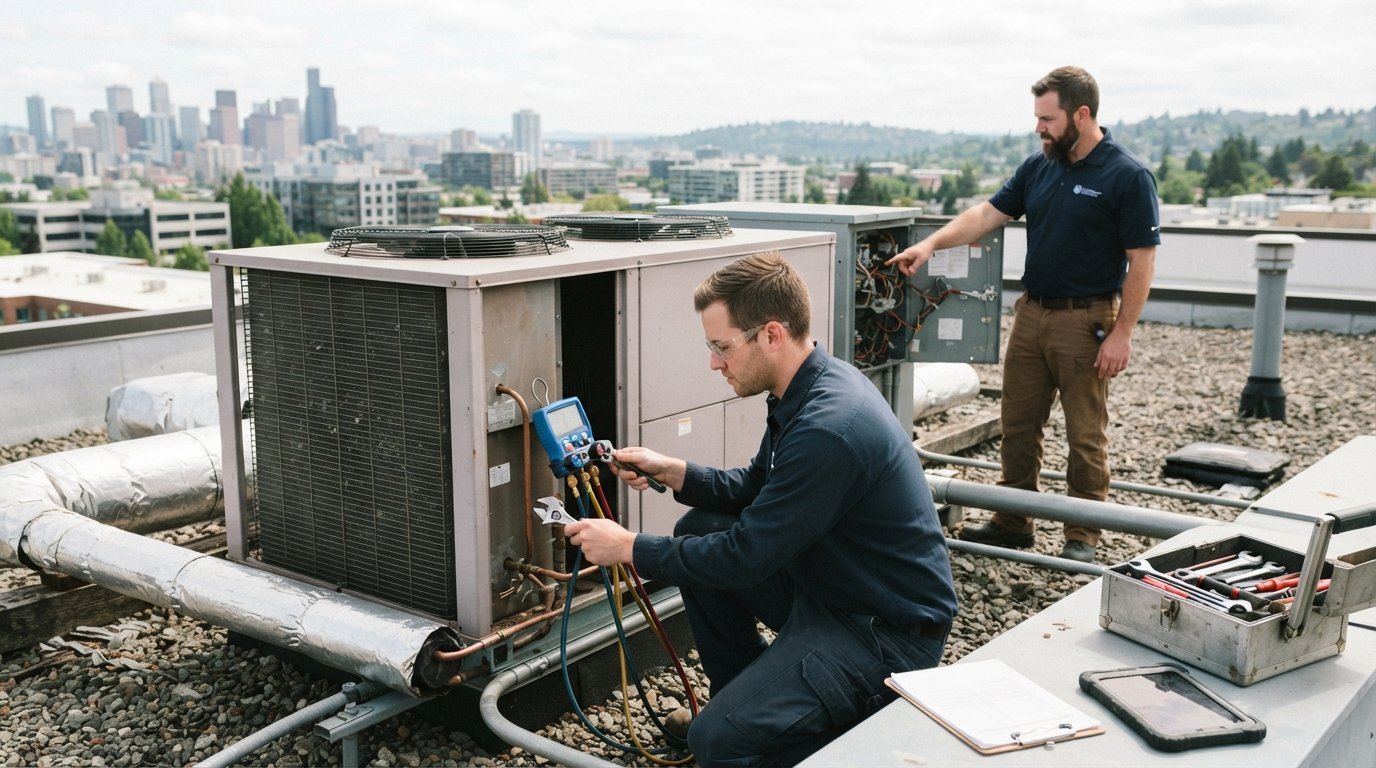
HVAC/R Technician Certificate: 12-Week Training in Washington
CITC's HVAC/R technician certificate can be finished in 12 weeks to under a year with hybrid training that prepares you for entry-level trade work.

By Harper Davis
Skilled trades remain one of the most reliable paths to a stable, well-paying career without a four-year degree, and few trades are as consistently in demand as heating, air conditioning, ventilation, and refrigeration. Buildings everywhere need working climate systems, and the technicians who install, maintain, and repair that equipment keep modern life comfortable and safe. For students in Washington State, the Construction Industry Training Council of Washington (CITC) offers a Heating, Air Conditioning, Ventilation and Refrigeration Maintenance Technology/Technician Certificate, 12 weeks to less than 1 year Mix of in-person and online at Construction Industry Training Council of Washington, a fast, flexible route into this essential field. This article breaks down what the program covers, how the hybrid format works, what it costs, and how to pay for it, so you can decide whether this credential fits your career goals.
Why HVAC/R Technicians Are in Demand
Heating, ventilation, air conditioning, and refrigeration systems are everywhere: homes, offices, hospitals, restaurants, data centers, warehouses, and schools. That ubiquity translates into steady work. Equipment wears out, refrigerants change, energy codes tighten, and building owners increasingly want efficient, well-maintained systems. The U.S. Bureau of Labor Statistics projects solid long-term demand for HVAC/R mechanics and installers, driven by new construction, retrofits, and the simple fact that climate control is not optional in most parts of the country.
Washington State adds its own dynamics. Mild but variable weather means both heating and cooling matter, and the region's focus on energy efficiency and green building standards keeps technicians busy upgrading older systems. Data centers in the Puget Sound area, food processing facilities in agricultural regions, and a growing population all feed demand for refrigeration and climate control specialists. Employers frequently report difficulty finding qualified entry-level technicians, which gives certificate holders a real advantage when applying for apprenticeships and helper roles.
The career also offers genuine progression. Many technicians start as helpers or installers, then move into service work, controls, commissioning, or supervision. Some eventually start their own businesses or specialize in commercial refrigeration, a niche that pays particularly well. A short certificate does not guarantee any specific salary or job, but it does give you documented, hands-on training that employers recognize and value.
Program Snapshot: Heating, Air Conditioning, Ventilation and Refrigeration Maintenance Technology/Technician Certificate, 12 Weeks to Less Than 1 Year Mix of In-Person and Online at Construction Industry Training Council of Washington
CITC is a well-known construction training organization in Washington, and its HVAC/R maintenance technician certificate is built for people who want to enter the trade quickly. The credential is classified as a Heating, Air Conditioning, Ventilation and Refrigeration Maintenance Technology/Technician Certificate, 12 weeks to less than 1 year Mix of in-person and online at Construction Industry Training Council of Washington, meaning you can finish in as little as three months or take somewhat longer depending on scheduling and course availability. That compressed timeline is one of the program's biggest selling points: you are not committing two years and tens of thousands of dollars before you earn your first paycheck.
The hybrid delivery model is another advantage. Online coursework covers the theory, safety fundamentals, electrical concepts, refrigeration cycle, and code-related topics, which you can complete around a job or family obligations. In-person sessions, held at CITC training facilities, give you supervised time with real equipment: furnaces, air conditioners, heat pumps, refrigeration units, meters, gauges, and hand tools. That combination matters because HVAC/R is a tactile trade. You can read about superheat and subcooling all day, but you learn to diagnose a system by putting your hands on it.
Students in this kind of program typically encounter the following core elements:
- Refrigeration theory, including the refrigeration cycle, refrigerants, and pressure-temperature relationships
- Electrical fundamentals, wiring diagrams, motors, controls, and troubleshooting with multimeters
- Heating systems, including gas furnaces, electric heat, and heat pumps
- Air conditioning and ventilation, including airflow, ductwork, and indoor air quality basics
- Safety, tools, and workplace practices, including EPA Section 608 refrigerant handling requirements
Exact course titles and sequencing can vary, so confirm current offerings directly with CITC. What matters is that the curriculum is designed to make you employable as an entry-level maintenance technician or installer helper, not to turn you into a finished journeyman on day one. The certificate is a launching pad, and the trade rewards people who keep learning on the job.
How the Hybrid Format Works in Practice
A typical week in the Heating, Air Conditioning, Ventilation and Refrigeration Maintenance Technology/Technician Certificate, 12 weeks to less than 1 year Mix of in-person and online at Construction Industry Training Council of Washington blends independent online study with scheduled hands-on sessions. You might complete reading modules, watch demonstration videos, and take knowledge checks online during the week, then attend a lab session where an instructor walks the class through a furnace sequence of operation or a refrigerant recovery procedure.
This structure suits a wide range of students. If you are working a day job, you may be able to complete online portions in the evening and attend labs on specific days. If you are a career changer coming from retail, food service, or warehouse work, the mix gives you time to absorb technical concepts without quitting your income entirely. If you are a recent high school graduate, the fast timeline means you can be interview-ready within a single season.
To succeed in this format, plan for the following:
- Treat online modules like appointments. Falling behind in theory makes lab time confusing and frustrating.
- Show up to every in-person session prepared, with safety glasses, gloves, and note-taking materials as required.
- Ask questions during labs. Instructors with field experience can explain why a reading looks wrong, not just what the textbook says.
- Practice with your tools outside class whenever possible, even simple tasks like stripping wire or reading a gauge manifold.
- Keep a log of systems you have seen and problems you have diagnosed, since that log becomes interview material.
One practical caution: hybrid programs require self-discipline. Nobody is watching you log in at night. Students who treat the online portion as a checkbox tend to struggle when they reach hands-on assessments. Students who engage with the material tend to finish strong and interview well.
Admissions, Costs, and What to Expect
CITC programs generally serve adults entering or advancing in the construction trades, and admission requirements for a maintenance technician certificate are typically straightforward: a high school diploma or equivalent, basic math and reading skills, and the ability to meet physical demands like lifting, climbing, and working in varied temperatures. Some students enter with prior mechanical experience, but many start with none. Because requirements and cohort schedules change, verify current admissions steps, start dates, and tuition directly with CITC before you apply.
Cost is a real consideration for any short-term training program. Tuition for a certificate like this is far less than a two-year degree, but you should still budget for tools, personal protective equipment, textbooks or online materials, and possibly transportation to lab sessions. Ask about payment plans, workforce development funding, and whether the program qualifies for federal student aid. Certificate programs can sometimes qualify for Pell Grants depending on length, eligibility, and the school's participation, and our guide on Pell Grant eligibility for certificate programs walks through how that works. Washington also has workforce programs, trade association scholarships, and employer tuition assistance that can reduce out-of-pocket costs.
Before enrolling, ask these questions:
- Is the program eligible for federal student aid or state workforce funding?
- What does tuition include, and what will I need to buy separately?
- Does the program prepare me for EPA Section 608 certification or other credentials?
- What job placement or employer connections does CITC offer graduates?
- How flexible are lab schedules if my work hours change?
Getting clear answers up front prevents unpleasant surprises later. It also helps you build a realistic budget and financial aid plan before the first day of class.
Paying for Training: Aid, Scholarships, and Strategy
Short-term trade programs are often more affordable than degree programs, but they still require planning. The main funding sources for a certificate like this include federal student aid (if the program qualifies), state workforce grants, trade association scholarships, employer tuition reimbursement, and personal savings. Veterans and military family members may also have education benefits that apply to approved certificate training.
Scholarship searches matter even for short programs. Many students assume scholarships are only for four-year degrees, but there are awards specifically for trade and technical students, including HVAC/R students. Trade unions, HVAC manufacturers, community foundations, and industry groups often fund small awards that can cover tools, tuition, or exam fees. For broader guidance on degree and career pathways, including how certificates fit into longer-term education plans, resources like CollegeDegrees.School provide useful overviews of higher education options. The key is to start early: many scholarships have deadlines months before the term begins.
A simple funding strategy looks like this:
- Confirm whether the program accepts federal aid and submit the FAFSA if it does.
- Check Washington State workforce and apprenticeship agencies for training grants.
- Search for HVAC/R-specific scholarships and trade association awards.
- Ask current or prospective employers about tuition assistance or tool stipends.
- Use a payment plan for any remaining balance rather than high-interest credit.
Do not overlook small awards. A five-hundred-dollar scholarship that covers a gauge set or a certification exam fee is worth the application time. Also note that Scholarship.Education receives compensation from listed schools via advertising, links, and search placement, which may influence their appearance, position, and ranking; the site does not include every school, and information is for general reference only, not legal, academic, or career advice.
Career Paths After the Certificate
Graduates of this kind of program typically enter the workforce as maintenance technicians, installer helpers, or service apprentices. From there, the trade offers multiple ladders. Residential service technicians learn to diagnose and repair home heating and cooling systems, often earning commissions or performance bonuses. Commercial technicians work on rooftop units, chillers, and building automation, and they often earn more as they gain experience and certifications. Refrigeration technicians specialize in supermarket racks, walk-in coolers, and industrial process cooling, a niche with strong pay and constant demand.
Certifications can accelerate advancement. EPA Section 608 certification is basically mandatory for anyone handling refrigerants. Manufacturer-specific training, NATE certification, and controls or building automation credentials can further increase your value. Some technicians eventually move into estimating, project management, or business ownership. Others use the trade as a foundation for related fields like energy auditing, facilities management, or mechanical engineering technology.
Entry-level pay varies by region, employer, and skill, and no program can promise a specific salary or job. That said, technicians who show reliability, troubleshoot methodically, and keep learning tend to do well. The trade rewards problem-solvers who are comfortable with tools, comfortable with customers, and willing to work in attics, crawlspaces, rooftops, and mechanical rooms. If that describes you, a certificate is a fast way to get your foot in the door.
Is This Certificate Right for You?
The Heating, Air Conditioning, Ventilation and Refrigeration Maintenance Technology/Technician Certificate, 12 weeks to less than 1 year Mix of in-person and online at Construction Industry Training Council of Washington fits students who want a practical, fast path into a skilled trade without relocating or pausing their lives for years. It suits career changers, recent graduates, veterans, and working adults who need flexibility. It is less suited to someone who wants a purely academic experience or who cannot commit to regular hands-on lab attendance, since the in-person component is where much of the real learning happens.
If you are comparing options, visit CITC, tour the training facility, talk to an instructor, and ask graduates about their experience. Then run the numbers: tuition, tools, transportation, and time, balanced against the income you can earn once you are working. For many students, the math works. A short, affordable certificate that leads to a hands-on career in an essential industry is a smart investment, especially when you stack scholarships, workforce grants, and employer assistance on top of it. Start by confirming current program details with CITC, filing your financial aid paperwork early, and applying for every relevant scholarship you can find. The demand for skilled HVAC/R technicians is not going away, and the sooner you start training, the sooner you can be the person buildings call when the heat goes out.