
HVAC Certificate Online and Hybrid Program Options
Explore HVAC certificate online and hybrid program options. Call (877)-218-7081 for guidance on training, certification, and funding your trade career.

By James Miller
Skilled trades are back in demand, and HVAC technicians sit near the top of that list. If you want to enter the field without spending four years on a traditional campus, you are probably weighing HVAC certificate online and hybrid program options. These formats blend the flexibility of remote coursework with the hands-on lab time employers expect, and they can shorten your path to a paycheck while keeping costs manageable. This guide breaks down what can be learned online, what must happen in a lab, how certification and apprenticeships work, and how to pay for it all without wrecking your budget.
What Online and Hybrid HVAC Training Actually Looks Like
An HVAC certificate is a short, career-focused credential, usually taking 6 to 18 months depending on whether you attend full time or part time. Online and hybrid programs deliver the same core curriculum as campus-based ones, but they split the work differently. In a fully online program, you complete theory modules through a learning management system, watch recorded lectures, submit assignments, and take quizzes remotely. In a hybrid program, you do the same academic work online but attend scheduled lab sessions at a partner facility or approved site to practice with real equipment.
The key distinction is that no legitimate HVAC certificate is 100 percent online. Federal regulations and industry standards require supervised hands-on training for the mechanical and safety competencies that define the job. That is why most reputable programs market themselves as hybrid, not fully remote. When you research HVAC certificate online and hybrid program options, look for clear disclosure of how many lab hours are required and where they take place. If a program promises a fully online HVAC credential with no hands-on component, treat that as a red flag.
Hybrid formats are especially useful for working adults, parents, and military learners who cannot relocate for a program. You can keep a current job while completing coursework at night, then schedule lab intensives on weekends or during a short residency period. The trade-off is that you must plan ahead for travel and time off if the lab site is not local. Some programs maintain regional lab partners, which cuts down on travel; others centralize labs at a single campus.
Online Theory vs Hands-On Skills: Where the Line Falls
Understanding the split between remote and in-person learning helps you evaluate programs realistically. The classroom portion of HVAC training covers the science and code knowledge that underpins every repair and installation. The lab portion builds the muscle memory, safety habits, and diagnostic instincts that customers pay for. Here is a practical breakdown of what you can expect in each category.
- Typically completed online: refrigeration theory, electrical fundamentals, thermodynamics, load calculation basics, code and safety regulations, customer service and business modules, and exam preparation for EPA Section 608 certification.
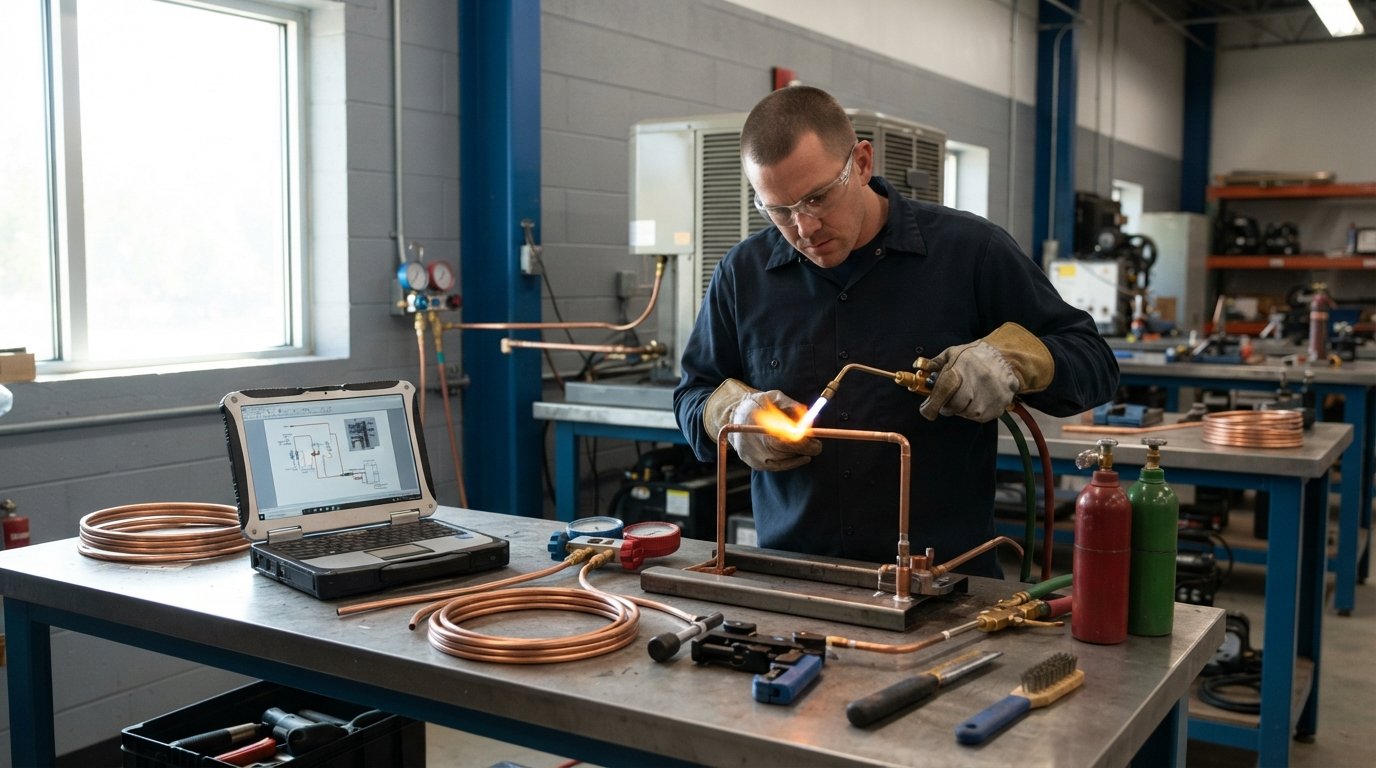
- Typically completed in a lab or on-site: brazing and soldering, refrigerant recovery and charging, electrical troubleshooting with multimeters, duct fabrication and sealing, system installation and commissioning, and diagnostic scenarios on live or simulator equipment.
- Often completed through apprenticeship or entry-level employment: real-world installation and service calls, customer interaction, and the judgment that comes from diagnosing equipment in the field.
This split matters because employers screen candidates on both knowledge and hands-on readiness. A hybrid program that provides structured lab time and documented competencies gives you a credible story in an interview. A program that skips the lab leaves you with theory you cannot apply, which is why apprenticeship pathways remain so important after graduation.
If you are comparing programs, ask for the lab-to-lecture ratio, the type of equipment used, and whether instructors are working technicians. Programs with strong lab components often publish photos of their training bays and list the specific tools and refrigerants students work with. That transparency is a good sign. For students who are still mapping out their education path, resources like our guide to accredited online nursing programs in Georgia show how hybrid formats are handled in another hands-on healthcare field, which can help you ask better questions about lab requirements.
EPA Certification and Apprenticeship Pathways After a Certificate
The Environmental Protection Agency requires technicians who handle refrigerants to hold Section 608 certification. Most HVAC certificate programs build EPA prep into the curriculum, and many administer the exam on campus or through a proctored remote session. Earning the credential before you graduate makes you more hireable immediately, because employers do not have to pay for or schedule your testing. Some programs also prepare you for OSHA 10 or 30 safety cards and manufacturer-specific training, which adds value on a resume.
After your certificate, the traditional next step is an apprenticeship or an entry-level technician role. Apprenticeships combine paid on-the-job training with related instruction, and they typically last three to five years. You do not need to complete an apprenticeship to work in many states, but it accelerates your path to journeyman status and higher pay. Some employers sponsor apprenticeships formally through registered programs; others provide informal on-the-job training with a senior technician. Either way, the certificate shortens the learning curve and signals commitment.
A practical sequence looks like this:
- Complete a hybrid HVAC certificate with a documented lab component.
- Pass the EPA Section 608 exam and any state-required licensing tests.
- Enter an entry-level technician or registered apprenticeship role.
- Accumulate field hours and pursue advanced certifications such as NATE or manufacturer credentials.
State licensing rules vary, so check your state's requirements before enrolling. Some states require a license for certain types of work, while others regulate only refrigerant handling. A good program will explain the rules for your region and help you plan the sequence.
Salary Ranges and Regional Demand for HVAC Technicians
HVAC technicians earn solid entry-level wages and see steady increases with experience and certifications. According to Bureau of Labor Statistics data, median pay for heating, air conditioning, and refrigeration mechanics and installers sits in the mid-$50,000s annually, with entry-level roles often starting in the high $30,000s to low $40,000s depending on market. Experienced technicians, especially those with commercial or refrigeration specialties, can earn well into the $70,000s and beyond. Overtime and emergency service calls add meaningful income in many markets.
Demand is strong nationwide because HVAC systems are everywhere and they break down in predictable cycles. Regions with extreme heat or cold see higher service volume, and fast-growing metro areas in the South and Southwest consistently need installers and service techs. Rural areas may have fewer openings but less competition. Commercial refrigeration and data center cooling are two niches with particularly strong demand and higher pay ceilings. If you are willing to relocate or specialize, your earning potential rises quickly.
Financing your training is often the bigger hurdle than finding work. Trade certificates qualify for several funding sources that students overlook. Here are the most common options to explore.
- Federal student aid: Many accredited certificate programs participate in Title IV aid, which means Pell Grants and federal loans may apply.
- State and local workforce grants: Workforce development boards frequently fund short-term trade training for in-demand occupations.
- Employer sponsorship: Some HVAC companies pay tuition or reimburse costs in exchange for a work commitment.
- Trade association scholarships: Groups like ACCA and local contractor associations offer small awards that can cover tools or tuition.
- Apprenticeship grants: Registered apprenticeships may include tuition assistance or paid related instruction.
Because costs vary widely by program and region, compare total program cost, not just tuition. Tools, EPA exam fees, transportation to lab sites, and lost wages during lab intensives all count. For a broader look at how families plan and pay for career-focused education, CollegeAndTuition offers plain-language guidance on financial aid and college cost planning that applies to trade programs as well as degrees.
How to Choose a Hybrid HVAC Program That Pays Off
The best program for you depends on your schedule, location, budget, and career goal. Start by confirming accreditation and whether the program participates in federal aid. Then verify the lab arrangement: where it is, how often you attend, and what equipment you will use. Ask about job placement rates, employer partnerships, and whether the school helps with EPA testing and apprenticeship placement. A program that is honest about its limits and specific about its outcomes is worth more than one with glossy marketing and vague promises.
Look for these features when comparing HVAC certificate online and hybrid program options:
- Clear disclosure of lab hours, location, and equipment
- EPA Section 608 exam preparation and testing access
- Instructors who are current or former field technicians
- Job placement support and employer partnerships
- Financial aid eligibility and transparent total cost
Also consider the pace. Accelerated programs get you to work faster but leave less room for a full-time job. Part-time and evening formats stretch the timeline but fit real life. Visit the lab if you can, talk to current students, and ask what happens if you fail a module or need extra lab time. Support services matter as much as curriculum.
Financing Trade Certificates Through Grants and Employer Sponsorship
Trade certificates are often more affordable than degrees, but they still require planning. Start with the Free Application for Federal Student Aid if your program is eligible, because it unlocks Pell Grants and federal loans. Then check your state workforce agency for short-term training grants tied to high-demand occupations; HVAC is frequently on those lists. Local community colleges and technical schools may also have scholarship funds specifically for trade students.
Employer sponsorship deserves more attention than it gets. Many HVAC contractors struggle to find qualified technicians, so they are willing to invest in training. Ask prospective employers whether they offer tuition reimbursement, tool allowances, or paid apprenticeships. Some companies partner directly with schools and hire students before graduation. If you are already working in a related trade, ask your current employer about upskilling support.
Finally, keep your total debt in proportion to your expected starting salary. A certificate that costs $15,000 and leads to a $40,000 starting job is manageable; one that costs $30,000 for the same outcome is not. Compare programs on cost per outcome, not just sticker price. Scholarship.Education receives compensation from listed schools through advertising, links, and search placement, which may influence how programs appear and rank. Use our resources as a starting point, verify details directly with schools, and treat all information as general reference rather than legal, academic, or career advice.
HVAC certificate online and hybrid program options give you a realistic path into a stable, well-paying trade without four years on campus. Choose a program with real lab time, plan for EPA certification, and line up funding before you enroll. The field rewards technicians who combine technical knowledge with hands-on skill, and a well-chosen hybrid program sets you up for both.