
History General Bachelor's at Carthage: 4-Year Guide
Explore the History General Bachelor's degree, usually 4 years In-person at Carthage College, and how aid cuts costs. Call (877)-218-7081 for guidance.

By Rachel Nguyen
Choosing a history degree is often framed as a choice between passion and practicality. At Carthage College, a private liberal arts institution in Kenosha, Wisconsin, the History General Bachelor's degree, usually 4 years In-person at Carthage College, is designed to blur that line. The program asks students to do more than memorize dates and names. It trains them to read critically, argue persuasively, and connect past decisions to present problems, skills that employers in law, education, business, and public service consistently say they need.
This guide walks through what the Carthage history major actually looks like, how the four-year timeline typically unfolds, what it costs, how financial aid and scholarships can reduce the price, and how to decide whether an in-person liberal arts education in Wisconsin is the right path for you. If you are comparing traditional and online routes, our breakdown of how to choose the best online college for a bachelor's degree offers a useful counterpoint on flexibility and cost.
What the History General Bachelor's Degree at Carthage College Involves
Carthage College awards a Bachelor of Arts in History. The "General" history track is the broadest version of the major: rather than specializing narrowly in one region or era, students sample widely across American, European, and global history while building a foundation in research methods and historiography. That breadth matters because it prepares graduates for a wider range of graduate programs and careers than a hyper-specialized major might.
Coursework generally falls into three buckets: survey courses that provide chronological and geographic grounding, topical seminars that dig into specific themes like revolutions, migration, or empire, and methods and capstone courses where students produce original research. Writing is not an add-on here; it is the core of the degree. Students should expect to write frequently, revise heavily, and present their work in class discussions.
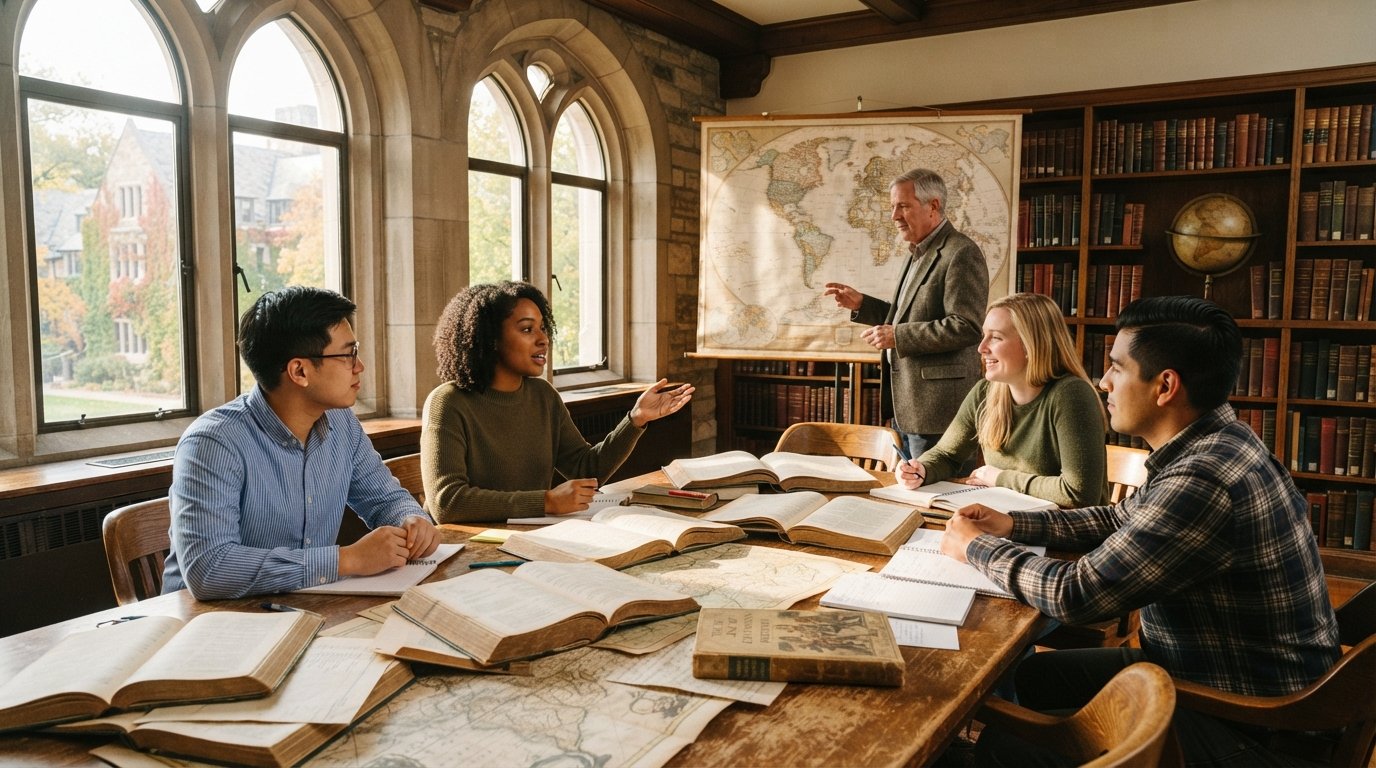
The in-person format is a genuine feature of this program, not a footnote. Small seminar rooms, face-to-face debate with professors who know your name, access to archives and library special collections, and the campus culture of a residential liberal arts college all shape how history is learned at Carthage. Students who thrive here tend to enjoy discussion, close reading, and the give-and-take of interpreting evidence in real time.
How the Four-Year Timeline Typically Unfolds
Most students complete the History General Bachelor's degree in eight semesters, though the exact sequence varies with transfer credit, study abroad plans, and double majors. The general rhythm looks like this:
- Year one: Complete general education requirements and introductory history surveys. This is also the year to meet your advisor, explore possible minors, and start building relationships with faculty.
- Year two: Move into upper-level courses across regions and periods. Students often declare the major this year and begin thinking about a minor that complements history, such as political science, economics, or a language.
- Year three: Take methods courses, consider study abroad or internship opportunities, and narrow interests. This is also the ideal window for research with faculty or archival work.
- Year four: Complete the capstone or senior seminar, finish remaining requirements, and prepare for graduation. Career planning, graduate school applications, and networking should be in full swing.
Because the program is usually completed in four years, students who stay on sequence avoid the extra cost and time of a fifth year. That said, adding a second major or a semester abroad may extend the timeline, so planning early with an advisor is essential. Carthage's semester calendar and January term also give students room to fit in internships or short-term study trips without derailing the four-year plan.
Admission Requirements and What Carthage Looks For
Carthage College reviews applicants holistically. There is no single cutoff that guarantees admission, but strong candidates typically present a solid high school GPA, a challenging course load that includes history and English, and evidence of curiosity beyond the transcript. Letters of recommendation, a personal essay, and extracurricular involvement all carry weight.
Prospective history majors do not need to have declared the major before applying. Many students arrive undecided and discover history after taking a survey course. That said, students who can articulate why they are drawn to the study of the past tend to write stronger applications. If you are a transfer student, the registrar will evaluate previous coursework for equivalency, and keeping syllabi from prior history classes can speed that process.
For students weighing a private liberal arts college against larger public universities, the key questions are class size, faculty access, and cost after aid. Carthage's in-person model is built around small classes and close mentoring, which some students find worth the investment and others do not. Running the net price calculator before applying is the single most useful step you can take.
Cost, Financial Aid, and Scholarships for History Majors
A private college education carries a sticker price that can look intimidating, but the number that matters is the net price after grants and scholarships. Carthage, like most private institutions, awards substantial institutional aid, and Wisconsin residents may also qualify for state grant programs. Federal aid, including Pell Grants and Direct Loans, is available to eligible students who complete the FAFSA.
History majors sometimes assume scholarships are reserved for STEM students, and that is a costly misconception. The skills history students develop, research, writing, and argumentation, are exactly what many scholarship committees look for. A practical funding strategy includes:
- Institutional merit awards: Apply early and submit strong essays; many colleges award these automatically based on the application.
- Departmental and alumni scholarships: History departments often have endowed awards that go underused because students never ask.
- External scholarships: Essay-based competitions, civic organizations, and heritage groups frequently fund liberal arts students.
- Federal work-study and state grants: Complete the FAFSA every year, even after freshman year.
Students who want to compare funding options across schools, including online alternatives, can use a degree matching service such as CollegeDegree.Education to explore accredited programs and request information without obligation. Just remember that any comparison should be based on net price and outcomes, not sticker price alone.
One additional note on transparency: Scholarship.Education receives compensation from listed schools through advertising, links, and search placement, which may influence how programs appear and rank. Always verify costs, accreditation, and program details directly with the institution before enrolling.
Skills You Build and Careers the Degree Opens
The stereotype of the unemployed history major does not survive contact with actual employment data. History graduates work in law, teaching, museums and archives, publishing, government, nonprofit management, communications, and business roles that reward clear writing and careful analysis. The degree is also a well-trodden path to graduate study in history, library science, law school, and public policy programs.
What employers tend to value most from history graduates is the ability to synthesize large amounts of information, identify what matters, and communicate a clear argument. Those are the same skills developed in seminar papers, primary source analysis, and class debate. Students who pair the major with an internship, a foreign language, or a complementary minor in data analysis or business strengthen their position considerably.
For students considering a career in education, the history major pairs naturally with teacher certification pathways, and for those eyeing law school, the reading and argumentation load of the major is excellent preparation. The bottom line is that the degree is versatile, but versatility only pays off when students actively build experience alongside it.
Is an In-Person Liberal Arts History Degree Right for You?
The in-person format at Carthage suits students who learn best through discussion, who want professors as mentors, and who value the structure and community of a residential campus. It is less ideal for students who need maximum scheduling flexibility, who live far from Wisconsin, or who cannot relocate. Those students may find that an online history or liberal arts program better fits their circumstances, and comparing both paths honestly is smart planning.
Prospective students should visit campus if possible, sit in on a history class, and talk with current majors. Ask about class sizes in upper-level seminars, capstone requirements, internship connections, and how the department supports students applying to graduate school. These conversations reveal more than any brochure.
Finally, treat the four-year timeline as a plan rather than a guarantee. Life circumstances, transfer credit, and changing goals all affect how long a degree takes. What matters is that the program, the cost after aid, and the format align with your goals before you commit.
The History General Bachelor's degree, usually 4 years In-person at Carthage College, rewards students who show up ready to read, write, and argue. For the right student, it is a rigorous and practical foundation for a wide range of careers, and with careful financial planning, it can be more affordable than the sticker price suggests.