
Fast-Track CNA Certificate at Deer Isle in Under 12 Weeks
Train for a CNA or patient care assistant role in under 12 weeks with in-person classes at Deer Isle Adult and Community Education. Local, fast, and career-focused.

Finding a healthcare career that you can enter quickly, without a four-year degree, and with real demand for your skills is rare. The Nursing Assistant/Aide and Patient Care Assistant/Aide Certificate, less than 12 weeks In-person at Deer Isle Adult and Community Education, is one of those rare pathways. In under three months, you can complete the training required to sit for the state competency exam and begin working as a certified nursing assistant (CNA) or patient care assistant (PCA). For adults on Maine's Blue Hill Peninsula who want to move into healthcare, this program offers a local, accelerated route to employment.
This article explains who the program is for, what you will learn, how the compressed schedule works, what it costs, and how to pay for it. You will also find practical steps for enrolling and a clear look at the job outlook for nursing assistants in Maine. If you have been considering a career change or a first step into nursing, the details below will help you decide whether this certificate fits your goals.
Who This Nursing Assistant Certificate Is For
This certificate is designed for adults who want to enter the healthcare workforce quickly. It suits career changers, recent high school graduates, parents returning to work, and anyone already working in a care setting who needs formal certification. Because the training is in-person at Deer Isle Adult and Community Education, it also serves residents of Deer Isle, Stonington, Sedgwick, Brooklin, and surrounding communities who prefer to learn close to home rather than commute to Bangor or Portland.
The program does not require a prior healthcare background. What it does require is a willingness to learn hands-on skills, comfort working with people, and the ability to complete the physical tasks of patient care. Students should be prepared for a fast pace: less than 12 weeks means the material moves quickly, and attendance matters.
Typical candidates include:
- Adults seeking a fast entry point into nursing or allied health careers
- Home caregivers who want formal CNA or PCA certification
- People interested in eventually pursuing LPN or RN training but who want to earn while they learn
- Displaced workers or those re-entering the job market in a high-demand field
If you fit one of these profiles, the next question is what the training actually covers and how the schedule is structured.
What the Certificate Covers and How the Schedule Works
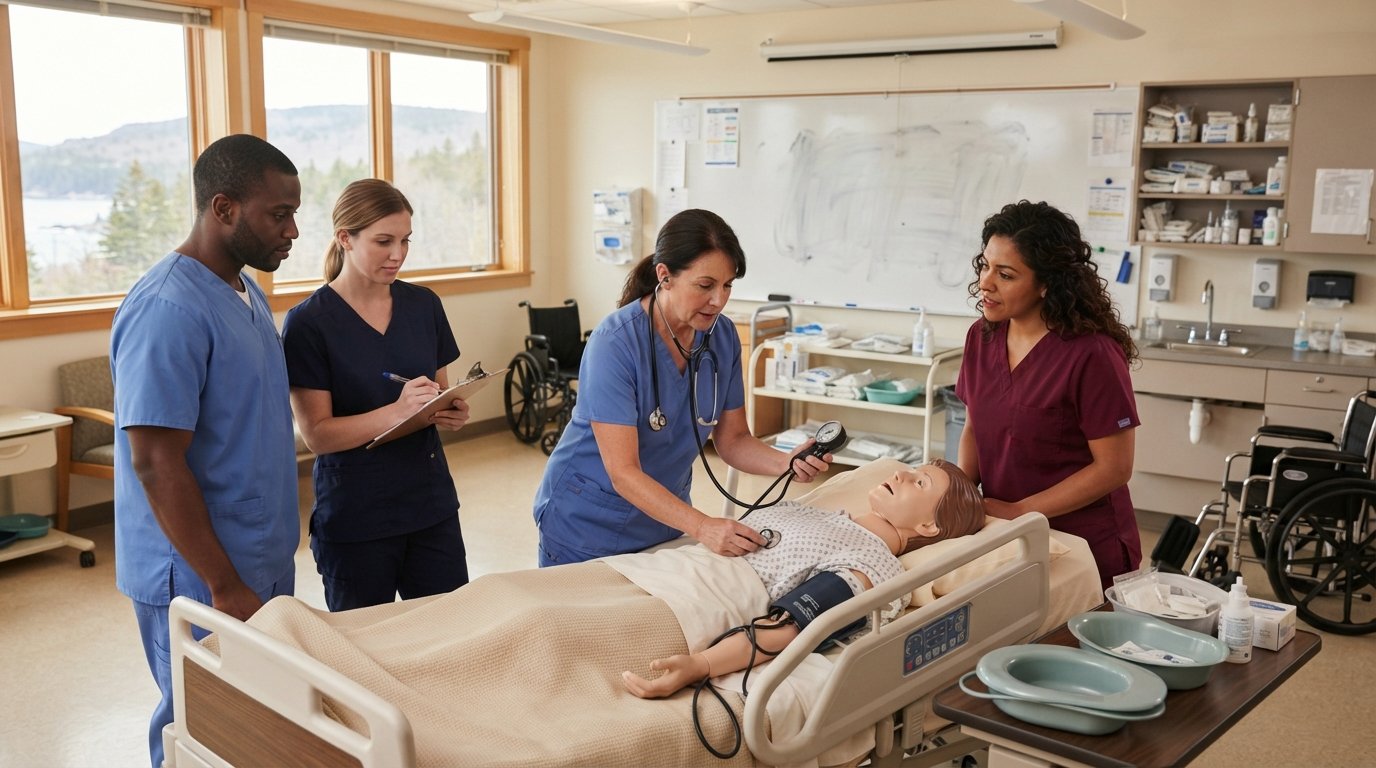
Nursing assistant and patient care assistant programs combine classroom instruction with supervised clinical practice. You can expect coursework in basic nursing skills, infection control, patient safety, communication, anatomy and physiology fundamentals, and the legal and ethical responsibilities of direct care workers. Clinical training usually takes place in a long-term care facility or similar setting, where you practice skills such as bathing, feeding, mobility assistance, and vital sign measurement under supervision.
The Deer Isle Adult and Community Education program compresses this content into less than 12 weeks of in-person instruction. That means several sessions per week, with classroom and lab time plus clinical hours. Because the program is in-person, you get immediate feedback from instructors and hands-on practice with equipment you will use on the job. This format is especially valuable for learners who want structure and direct supervision rather than a self-paced online course.
Students should plan for:
- Consistent attendance, since missed clinical hours often cannot be made up easily
- Physical tasks such as standing for long periods and assisting with patient movement
- Reading and testing requirements, including a final written exam and a skills demonstration
- Background checks and health documentation, such as immunizations, before clinical placement
After completing the certificate, graduates are typically eligible to take the state competency exam required for CNA certification. Passing that exam is what allows you to work as a certified nursing assistant in Maine. The certificate itself is the training step; the exam is the credentialing step.
Cost, Financial Aid, and Funding Options
Cost is often the biggest concern for adult learners, and it is worth knowing that short certificate programs like this one are frequently more affordable than degree programs. Even so, tuition, fees, textbooks, uniforms, and the certification exam fee add up. The good news is that several funding sources can reduce or eliminate your out-of-pocket costs.
Start with the Free Application for Federal Student Aid (FAFSA). Many certificate and adult education programs are eligible for federal student aid, and the Pell Grant can help cover tuition for qualifying students. For a detailed look at how the Pell Grant applies to short-term programs, see this guide on Pell Grant eligibility for certificate programs. It explains how eligibility works and what to check before you enroll.
Other funding options to explore include:
- Maine workforce development grants and career training scholarships
- Employer tuition assistance if you already work in a healthcare or caregiving setting
- Local community foundation scholarships and adult education funding
- Apprenticeship or earn-while-you-learn programs offered by some long-term care employers
Because this program is offered through an adult and community education department, staff can often point you toward local funding sources and help you complete aid forms. Ask about payment plans as well. Many adult education programs allow tuition to be paid in installments, which can make the cost manageable while you train.
It is also worth comparing this local option with broader program discovery tools. If you want to explore other healthcare training pathways, a resource like CollegeDegree.Education can help you compare accredited programs and understand your options before committing.
Why Choose an In-Person Program at Deer Isle Adult and Community Education
Online CNA programs exist, but hands-on care skills are learned by doing. In-person training gives you access to practice labs, clinical placements, and instructors who can correct your technique in real time. For many adult learners, the structure of a scheduled in-person class also improves completion rates compared with self-paced study.
Deer Isle Adult and Community Education adds another advantage: location. If you live on the peninsula, you avoid long commutes and can fit training around family and work obligations more easily. Adult education programs also tend to be flexible and supportive, with smaller classes and instructors who know their students by name.
Consider these benefits of the in-person format:
- Direct supervision during clinical skills practice
- Immediate feedback and correction from licensed instructors
- Peer study groups and networking with local healthcare employers
- Access to local job leads and placement support
For a field where trust and competence matter, learning face to face is a strong choice.
Career Outlook and Next Steps After Certification
Nursing assistants remain in high demand, particularly in long-term care, home health, and hospitals. In Maine, an aging population means steady need for direct care workers. The Bureau of Labor Statistics projects continued demand for nursing assistants nationally, and Maine employers frequently report shortages in this role. That translates into job security and often flexible scheduling for certified workers.
After passing the competency exam, you can apply for CNA positions in nursing homes, assisted living facilities, hospitals, and home health agencies. Some employers offer tuition assistance for CNAs who want to advance to LPN or RN programs, which makes this certificate a practical stepping stone rather than a dead end.
To move forward with the Nursing Assistant/Aide and Patient Care Assistant/Aide Certificate, less than 12 weeks In-person at Deer Isle Adult and Community Education, take these steps:
- Contact Deer Isle Adult and Community Education to confirm the next start date and admission requirements.
- Complete the FAFSA and ask about local scholarship and workforce funding options.
- Gather required documents, including immunization records and background check paperwork.
- Plan your schedule to ensure full attendance for the duration of the program.
- Prepare for the state competency exam during the final weeks of training.
With a short timeline, local instruction, and strong demand for graduates, this certificate is a realistic way to launch a healthcare career without a long or expensive detour. If you are ready to take the next step, reach out to the program office and ask about upcoming cohort dates and funding support.