
Erie Community College Mathematics Associate's Degree
The Mathematics, General Associate's degree, usually 2 years In-person at Erie Community College offers a low-cost, transfer-friendly path to a four-year math degree.

By Julian Walsh
Choosing a college path in mathematics does not always require a four-year commitment from day one. For students who want a strong foundation in quantitative reasoning without the immediate cost and pressure of a university, the Mathematics, General Associate's degree, usually 2 years In-person at Erie Community College offers a practical and affordable entry point. Erie Community College, part of the SUNY system and located in Western New York, has built a reputation for accessible, career-focused and transfer-friendly programs. Its general mathematics associate's degree sits at the intersection of those priorities: it prepares graduates to move directly into the workforce in roles that value analytical skill, or to transfer into a bachelor's program with junior standing. This article walks through what the program covers, who it suits, how to pay for it, and how to make the most of the in-person experience.
What the Mathematics, General Associate's Degree at Erie Community College Involves
The Mathematics, General Associate's degree, usually 2 years In-person at Erie Community College is designed as a broad foundation rather than a narrow specialization. Students take a sequence of calculus and post-calculus courses, typically including Calculus I, Calculus II, Calculus III, and Differential Equations, alongside a supporting base in physics, computer science, and general education. The general track differs from a strict transfer track in that it allows more elective room, so students can tailor coursework toward data analysis, statistics, engineering prerequisites, or education pathways depending on their goals.
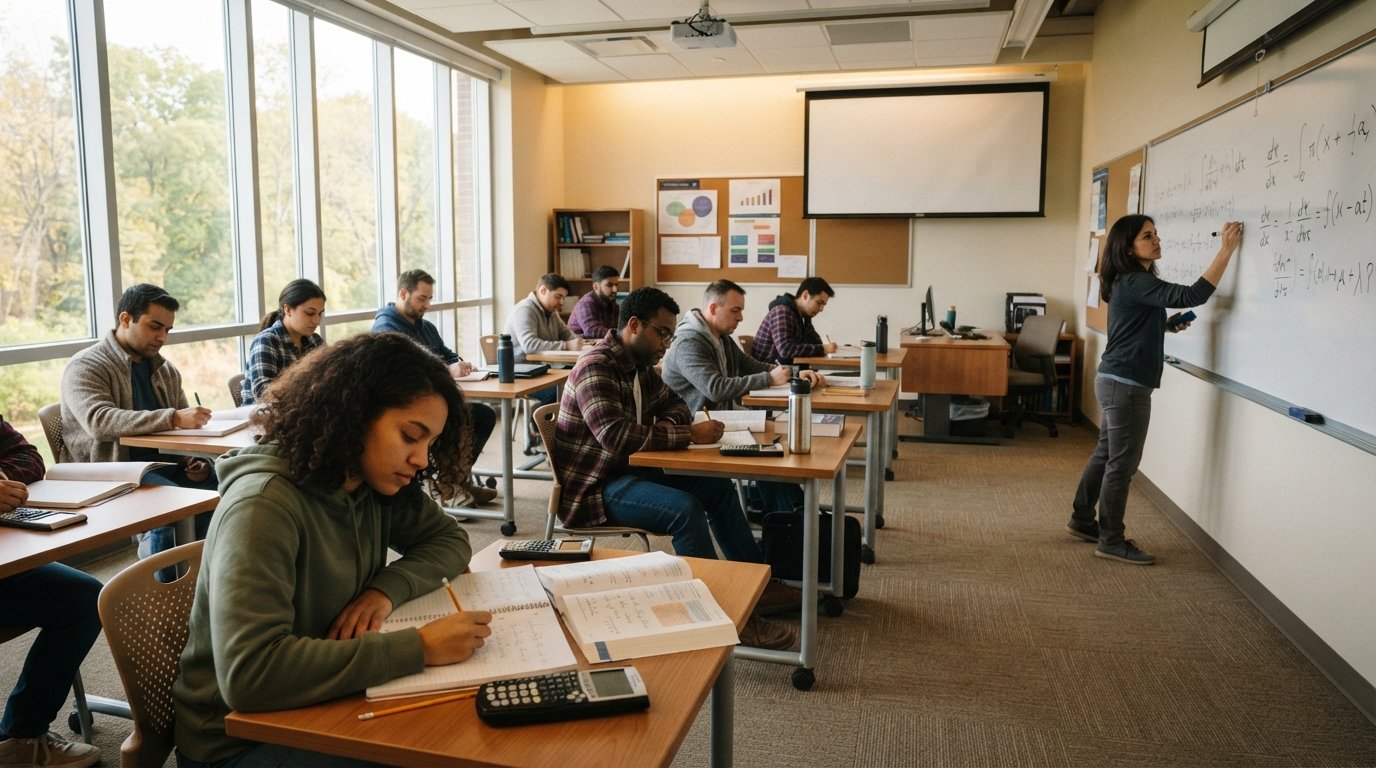
Because the program is delivered in person, students benefit from regular access to faculty office hours, peer study groups, and campus math labs. Mathematics is one of those subjects where a live conversation about a difficult proof or a stubborn integral often saves hours of solitary frustration. Erie Community College's campuses in Buffalo, Orchard Park, and Williamsville give students the option to study close to home while still engaging with a full college environment.
Coursework generally breaks down into a few recognizable blocks:
- Core mathematics: Calculus I through III, linear algebra, and differential equations form the spine of the degree.
- Supporting sciences: Physics sequences and often a computer programming course reinforce applied problem solving.
- General education: English composition, social sciences, and humanities round out the associate's degree requirements.
- Electives: Students choose from statistics, discrete mathematics, or additional science courses depending on transfer targets.
That structure matters because it keeps doors open. A student who finishes the general mathematics associate's degree can apply to a four-year institution as a math major, a statistics major, an education major with a math concentration, or even a computer science program, provided the electives line up. Advisors at Erie Community College typically encourage students to decide on a transfer destination by the end of the first year so that course selection stays efficient.
Who Should Consider This In-Person Associate's Degree
The Mathematics, General Associate's degree, usually 2 years In-person at Erie Community College is not a one-size-fits-all credential. It fits best for students who learn well in structured environments and want a lower-cost on-ramp to a math-intensive career. That includes recent high school graduates who are not yet ready to leave home, adult learners returning to school after years away, and career changers who need quantitative credentials before applying for analytical jobs or further study.
Students who thrive in this format tend to share a few traits. They are comfortable with daily or weekly campus attendance, they value face-to-face instruction, and they are willing to use tutoring and office hours when a topic gets hard. Mathematics at the associate's level moves quickly, and the in-person format rewards students who engage actively rather than passively watching lectures.
It is also a strong option for students planning to teach. New York and many other states have specific pathways for math teachers, and an associate's degree in general mathematics can satisfy the lower-division subject requirements before transfer into an education bachelor's program. Similarly, students aiming at engineering technology, actuarial work, or data support roles often find the degree's mix of calculus and computing courses useful.
One caveat deserves emphasis: if a student's goal requires a specific four-year program with narrow prerequisites, such as certain engineering specialties, it is worth confirming course equivalencies early. Erie Community College advisors and transfer services exist precisely to prevent wasted credits, and using them is part of getting value from the program.
Cost, Financial Aid, and the Transfer Equation
Cost is often the deciding factor for students comparing a community college mathematics pathway with a direct four-year enrollment. Erie Community College's tuition is set at the SUNY community college rate, which is substantially lower than most four-year institutions, particularly for students who qualify for in-state or county-based pricing. For many families, completing the first two years at ECC and then transferring can cut the total cost of a bachelor's degree significantly.
Financial aid works through the standard federal and state channels. Students complete the FAFSA, which determines eligibility for Pell Grants, federal work-study, and federal student loans. New York residents may also qualify for state aid such as the Tuition Assistance Program, and Erie Community College's financial aid office can help students identify institutional scholarships and emergency funds. Students exploring broader funding options can review this guide to community college grants and financial aid options to understand how grants, work-study, and scholarship deadlines fit together.
Beyond federal and state aid, a few practical strategies help mathematics students reduce costs:
- File the FAFSA as early as possible each year, since some aid is awarded on a first-come basis.
- Apply for departmental and STEM-focused scholarships, which often go underused at community colleges.
- Ask about textbook alternatives and open educational resources, which can save hundreds of dollars per semester in math and science courses.
- Meet with a transfer advisor to confirm that credits will apply toward the bachelor's program, avoiding the hidden cost of repeated coursework.
For students and families comparing total college costs across institutions, resources such as CollegeAndTuition can help frame the long-term financial picture, including tuition trends and planning considerations. The key insight is that the associate's degree is not simply a cheaper credential; it is a financial strategy that preserves the option of a four-year degree at a lower cumulative price.
Building a Transfer Plan From Day One
The most common mistake students make with a general associate's degree in mathematics is treating transfer as a senior-year decision. At Erie Community College, the stronger approach is to build a transfer plan during the first semester. That means identifying two or three target four-year institutions, reviewing their math major requirements, and mapping ECC courses against them with an advisor.
New York's transfer environment is relatively favorable. SUNY has system-wide transfer policies, and many private colleges in Western New York maintain articulation agreements with Erie Community College. Students who complete the Mathematics, General Associate's degree, usually 2 years In-person at Erie Community College with a solid grade point average often enter four-year programs with junior standing, which means two more years rather than three or four.
A workable transfer timeline looks like this. In the first semester, meet with an advisor and declare an intent to transfer. In the second semester, attend transfer fairs and request information from target schools. By the end of the first year, finalize a short list and confirm course equivalencies in writing. During the second year, complete applications, apply for transfer scholarships, and submit transcripts early. Students who follow a sequence like this rarely encounter surprise credit losses.
Grade point average also matters more than many students expect. Mathematics courses build on each other, so a weak grade in Calculus I tends to create problems in Calculus II. Retaking a course is possible, but it costs time and money. Consistent effort, use of the math lab, and early help-seeking are the practical defenses.
Career Paths and Further Study After the Degree
An associate's degree in general mathematics is not a terminal credential for most students, but it does open several immediate paths. Graduates sometimes move directly into roles such as data entry analyst, actuarial assistant, statistical clerk, tutoring coordinator, or paraeducator. These positions value quantitative competence and often provide tuition benefits that help employees continue their education.
More commonly, graduates use the degree as a stepping stone. The most natural next step is a bachelor's degree in mathematics, applied mathematics, statistics, or mathematics education. From there, career options expand into actuarial science, data science, operations research, secondary teaching, and graduate study. Students interested in healthcare analytics or engineering technology sometimes combine the math foundation with a specialized bachelor's program.
It is worth being honest about the limits of the credential. Most professional mathematician and statistician roles require at least a bachelor's degree, and many research roles require a master's or doctorate. The associate's degree's value lies in lowering the cost and risk of the first two years while keeping those advanced paths available. Students who understand that framing tend to use the program well.
Making the Most of the In-Person Experience
Because the program is delivered in person, students have access to resources that online learners often lack. Erie Community College's math labs, tutoring centers, and faculty office hours are free or low-cost supports that directly affect performance in calculus and differential equations. Students who attend class regularly and form study groups tend to outperform those who treat the degree as a set of independent online modules.
Extracurricular and professional development opportunities also matter. Math clubs, STEM events, and transfer fairs provide information and connections that are hard to replicate remotely. Internships and part-time roles in tutoring or data support can strengthen transfer applications and resumes. Faculty recommendations, which matter for scholarships and some transfer programs, are far easier to earn when instructors know a student by name.
The Mathematics, General Associate's degree, usually 2 years In-person at Erie Community College is ultimately a flexible tool. It suits students who want a rigorous but affordable mathematical foundation, a clear transfer pathway, and the structure of a real campus. For those who plan early, use advising, and take advantage of in-person supports, it can be one of the more sensible financial and academic decisions available in Western New York.