
Electrician Associate's Degree: 2-Year Hybrid at Bellingham Tech
The Electrician Associate's degree, usually 2 years Mix of in-person and online at Bellingham Technical College, blends hands-on labs with flexible theory for a faster trade career.

By Julian Walsh
What if you could train for a skilled trade that keeps homes and businesses powered while earning a degree that combines hands-on shop time with the flexibility of online coursework? That is the reality for students considering the Electrician Associate's degree, usually 2 years Mix of in-person and online at Bellingham Technical College. This program model is gaining attention because it fits the realities of modern learners: apprentices who need flexible theory classes, career changers who cannot relocate, and high school graduates who want a clear path to a living-wage job without four years of university tuition.
Bellingham Technical College, located in Washington State, has built a reputation for applied, technical education. Its electrician pathway blends the safety and dexterity of in-person lab work with the convenience of online instruction for code, theory, and business math. For students comparing trade schools, community colleges, and apprenticeship routes, understanding how this hybrid format works is the first step toward a smart decision. The sections below break down the curriculum, the online and in-person mix, costs, financial aid, career outcomes, and the practical steps to apply.
Why a Hybrid Electrician Associate's Degree Makes Sense in 2026
The electrical trade is not disappearing. Data centers, solar installations, electric vehicle charging stations, and grid modernization are all driving demand for licensed electricians. Yet the traditional path, a four-year apprenticeship with night classes, does not fit everyone. A two-year associate's degree offers a structured, credit-bearing alternative that can transfer into apprenticeship hours or qualify graduates for entry-level roles faster. The hybrid format, mixing in-person and online instruction, removes two common barriers: geography and scheduling.
Students who live outside Bellingham or who work during the day can complete theory modules online, then attend campus labs for hands-on practice with conduit bending, wiring, motor controls, and safety procedures. This is not a fully online degree, and that distinction matters. Electrical work is physical and code-driven; you cannot learn to terminate a panel or troubleshoot a circuit safely through a screen alone. The program's design acknowledges this by keeping lab time in person while moving lecture content to a flexible online format.
For students exploring trade-focused programs, the ability to compare formats is valuable. A practical checklist for tech requirements for online courses can help you confirm that your laptop, internet, and software meet the demands of online electrical theory modules before you enroll. That small step prevents the frustration of falling behind in week one because a learning management system will not load.
What the Curriculum Covers: From Ohm's Law to National Electrical Code
The Electrician Associate's degree, usually 2 years Mix of in-person and online at Bellingham Technical College, is structured to build competence layer by layer. Early coursework covers electrical theory, direct and alternating current, safety, and tool use. Mid-program courses move into residential and commercial wiring, conduit fabrication, blueprint reading, and the National Electrical Code. Later courses often include motor controls, programmable logic controllers, low-voltage systems, and an introduction to the business side of contracting.
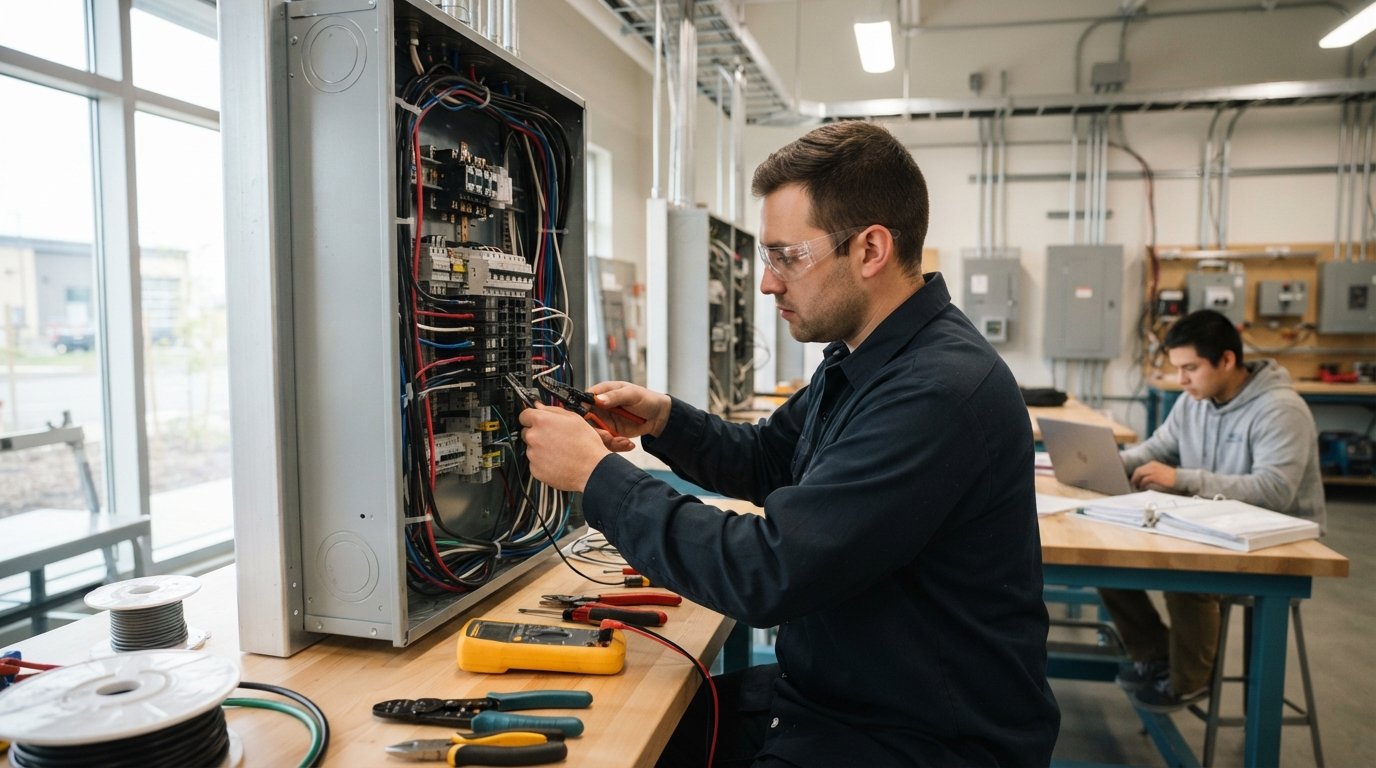
In-person lab sessions are where theory becomes muscle memory. Students bend conduit to precise angles, wire three-way switches, test circuits with multimeters, and practice lockout/tagout procedures. Online components typically include code study, math for electricians, safety modules, and written assignments. This blend means a student might watch a lecture on grounding requirements online, then apply that knowledge in a lab the same week.
Here is a representative breakdown of how the two years might be organized:
- Year 1: Electrical fundamentals, safety, basic wiring, code introduction, and applied math, with weekly or biweekly campus labs.
- Year 2: Commercial and industrial wiring, motor controls, troubleshooting, and a capstone or internship-style project, with advanced labs and online theory.
- General education: Communication, technical math, and workplace skills, often delivered online to reduce campus trips.
Exact course titles and sequencing vary by catalog year, so students should confirm the current degree map with an advisor. What stays consistent is the philosophy: hands-on skills are taught face to face, while supporting knowledge is delivered with flexibility. This structure also supports working adults who need to keep a job while they retrain.
Admissions, Costs, and Financial Aid for Trade Students
Admission to a technical college electrician program is generally less selective than a university engineering program, but it is not automatic. Applicants typically need a high school diploma or equivalent, placement in college-level math and English (or co-requisite support courses), and sometimes a brief interview or advising session. Some programs require a placement test or accept prior coursework. Because electrical work involves safety-sensitive tasks, students should also expect physical requirements: lifting, climbing, color vision, and the ability to work in varied conditions.
Cost is where the associate's degree model often wins. Two years of in-state technical college tuition is far less than four years at a university, and trade programs frequently qualify for federal student aid, state grants, and institutional scholarships. Students should file the FAFSA early, apply for Washington state need-based grants, and ask the financial aid office about workforce development funds. Some employers and unions also offer tuition assistance or reimbursement for approved programs.
For families mapping out college costs, broader planning resources at CollegeAndTuition can help compare tuition, fees, and aid options across institutions. The key is to treat the electrician degree like any other investment: calculate total cost, estimate aid, and compare that figure against expected starting wages. A two-year program with modest debt and strong placement can outperform a four-year degree with heavy loans in this field.
Online vs. In-Person: What to Expect Week to Week
The hybrid format is not simply a convenience; it changes how students learn. Online theory modules usually include recorded lectures, readings, quizzes, and discussion boards. Students can complete these around work shifts, childcare, or other commitments. In-person labs are scheduled blocks, often two or three times per week, where attendance is mandatory because safety and skill sign-off happen in the shop.
Students who thrive in this model tend to be self-directed and organized. They treat online coursework like a job, blocking out study hours and submitting work before deadlines. They also prepare for labs by reviewing the relevant theory first, so shop time is spent practicing rather than catching up. Those who struggle are often the ones who treat online modules as optional; the flexibility is real, but so are the deadlines.
Technology access is another consideration. Online electrical courses may require a reliable computer, a webcam for proctored exams, and stable internet. Students without home access can use campus computer labs, but planning ahead prevents last-minute scrambles. The earlier checklist on online course tech requirements is worth revisiting if you are unsure whether your setup is sufficient.
Career Outcomes and Licensure Pathways in Washington
Graduates of an electrician associate's degree do not automatically become licensed journeyman electricians; licensure requires supervised work hours and passing exams. However, the degree can count toward related instruction requirements and may shorten the time needed to reach journey-level status. In Washington, electricians typically progress through trainee, journeyman, and master categories, with each step requiring documented hours and testing.
Entry-level opportunities for program graduates include electrical apprentice, maintenance helper, solar installer, low-voltage technician, and residential wiring assistant. With experience and licensure, earnings rise substantially. Electricians in Washington earn well above the state minimum wage, and demand is steady across construction, manufacturing, and infrastructure sectors. The degree also opens doors to supervisory roles, estimating, and electrical contracting for those who later pursue business coursework.
Students should be realistic: the degree is a launchpad, not a finish line. The most successful graduates combine their coursework with paid work in the field, even if that means starting as a helper while finishing the program. That combination of classroom knowledge and real-world hours is what employers value most.
How to Apply and Succeed in the Program
Applying to a hybrid electrician program is straightforward if you follow a sequence. Start by reviewing the college catalog and confirming the current degree requirements. Then complete admissions steps, including transcripts, placement, and any required advising. File the FAFSA and apply for state and institutional aid. Finally, register early for lab sections, since hands-on seats are limited and fill quickly.
Once enrolled, success comes down to habits. Here is a practical framework that high-performing trade students tend to follow:
- Map the entire two-year schedule in your first quarter so you know which online and in-person courses must align.
- Treat lab days as mandatory and arrive prepared, with readings and safety modules completed in advance.
- Build relationships with instructors and lab technicians; they are your best source for apprenticeship leads and references.
- Track your work hours from day one if you are pursuing licensure, because documentation gaps delay advancement.
- Review your budget each term and apply for scholarships before deadlines, not after.
These habits matter more than raw talent. Electrical work rewards consistency, safety consciousness, and attention to detail, and the hybrid format rewards students who manage their time well. Advisors and financial aid counselors can help when challenges arise, but the initiative has to come from the student.
Is the Electrician Associate's Degree Right for You?
The Electrician Associate's degree, usually 2 years Mix of in-person and online at Bellingham Technical College, suits students who want a structured, affordable path into a skilled trade without sacrificing flexibility. It is a strong fit for career changers, recent high school graduates who prefer applied learning, and working adults who need online theory to accommodate their schedules. It is a weaker fit for someone seeking a fully remote program or a four-year engineering track.
Prospective students should visit campus, meet instructors, and ask pointed questions about lab access, licensure support, and job placement. Compare the program against local apprenticeships and other technical colleges, and weigh total cost against realistic earnings. For students who do that homework, a hybrid electrician degree can be one of the most practical investments in higher education available today.