
Electrical/Electronic Engineering Technician Certificate in 12 Weeks
The Electrical/Electronic Engineering Technologies/Technicians, Other Certificate at Ashland County-West Holmes Career Center builds job-ready skills in 12 weeks to under a year.

By Julian Walsh
Skilled electrical and electronic engineering technicians are the people who keep modern industry running. They install, test, maintain, and repair the electrical systems and electronic equipment that power everything from manufacturing floors to hospital imaging suites. If you want to enter this field without committing to a multi-year degree, the Electrical/Electronic Engineering Technologies/Technicians, Other Certificate, 12 weeks to less than 1 year In-person at Ashland County-West Holmes Career Center offers a fast, hands-on path to job-ready skills. This short certificate is designed for adults who need practical training quickly, whether they are launching a first career, changing industries, or adding a credential to their current role. Below, we break down what the program covers, who it suits, how to pay for it, and how to decide whether it fits your goals.
What This Electrical/Electronic Engineering Technician Certificate Covers
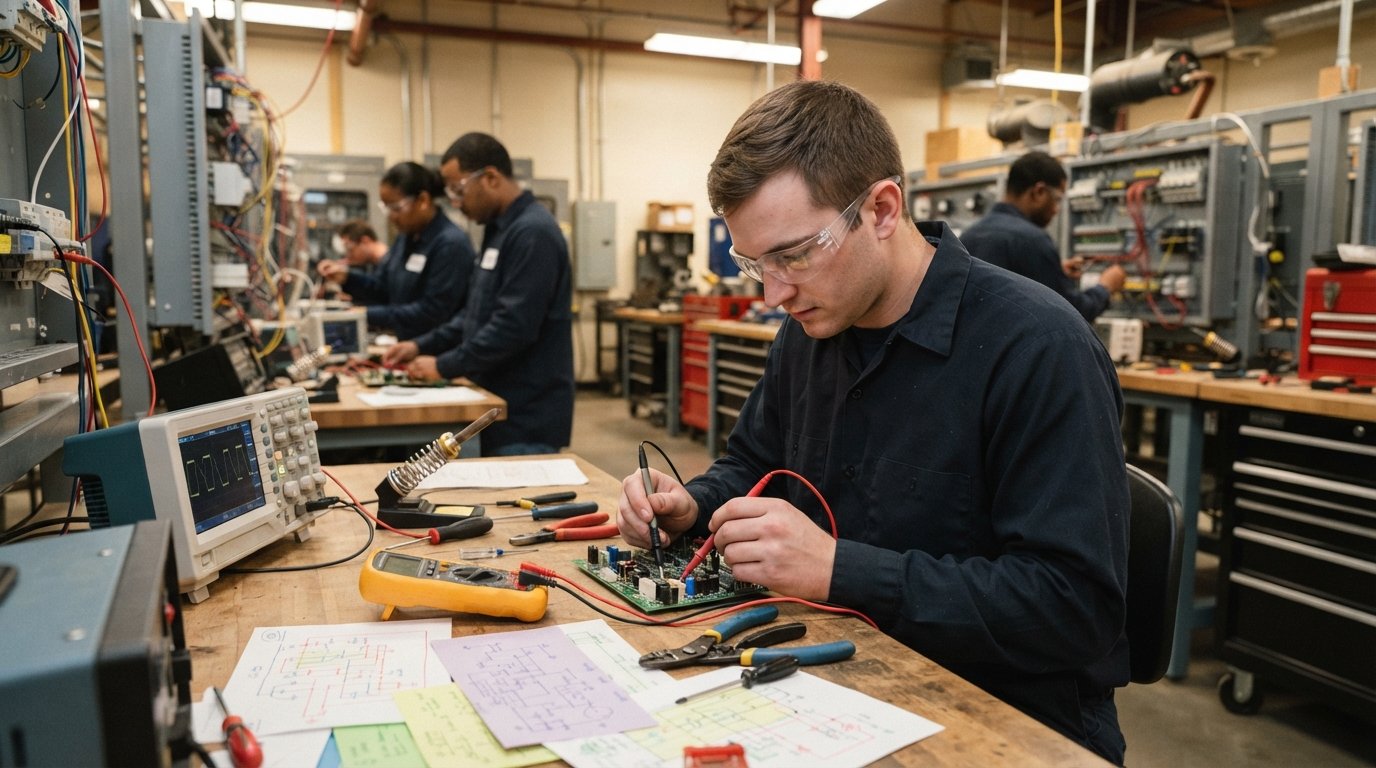
The program falls under the broad federal classification of Electrical/Electronic Engineering Technologies/Technicians, Other, which means it teaches the applied, hands-on side of electrical and electronic engineering rather than the theoretical design work of a four-year engineering degree. Students learn how circuits work, how to read schematics, how to use test instruments such as multimeters and oscilloscopes, and how to troubleshoot faults safely. Because the credential can be completed in 12 weeks to less than 1 year, the curriculum is tightly focused on the skills employers actually ask for in entry-level technician roles.
In-person delivery matters here. Electrical work is physical and safety-sensitive, so hands-on lab time under an instructor's supervision builds confidence in a way that online videos cannot replicate. Students typically practice wiring circuits, measuring voltage and current, testing components, and following lockout and safety procedures. The schedule is intensive but short, which means learners can move from the classroom to the job market in a single semester or slightly longer, depending on the exact track and start date.
Graduates are prepared for roles with titles such as electrical technician, electronics technician, maintenance technician, field service technician, or production test technician. These positions appear across manufacturing, utilities, telecommunications, automation, and building maintenance. The certificate does not replace an associate degree, but it does give you a recognized credential and demonstrable lab experience that can open doors to entry-level hiring and apprenticeship-style roles.
Who Should Enroll in a 12-Week to Under-1-Year Certificate
Short certificates are not for everyone, but they are an excellent fit for specific types of learners. The strongest candidates are people who want to start earning quickly, prefer learning by doing, and are comfortable with math and basic physics concepts. If you have ever enjoyed fixing electronics, wiring a workshop, or figuring out why a machine stopped working, this kind of program can turn that curiosity into a career.
The following groups tend to benefit most from this format:
- Recent high school graduates who want a fast route into technical employment before deciding on further education.
- Career changers from retail, warehouse, construction, or automotive backgrounds who already have mechanical aptitude.
- Working adults who need evening or short-term training that fits around existing jobs.
- Maintenance staff in factories or facilities who want formal credentials to support a promotion.
- Veterans and military spouses seeking rapid, portable skill certification.
It is equally important to be honest about who may need a longer path. If your goal is engineering design, research, or a licensed professional engineer title, you will eventually need a full degree. For that longer route, our guide to a CCCC Electrical Engineering Technology Degree Guide explains how associate and bachelor's programs build on foundational technician training. Many students use a short certificate as a stepping stone, working in the field while continuing their education part time.
Skills and Knowledge You Will Build
Even in a compressed program, the core competencies are consistent across most electrical and electronic technician curricula. Expect a blend of classroom instruction and lab work, with assessments that require you to demonstrate procedures rather than simply recall facts. Instructors typically emphasize safety first, because electrical work carries real hazards and employers expect new hires to understand basic protective practices from day one.
Key skill areas usually include:
- Reading and interpreting electrical schematics, wiring diagrams, and manufacturer documentation.
- Using test equipment such as multimeters, clamp meters, and oscilloscopes to diagnose faults.
- Understanding direct current (DC) and alternating current (AC) circuit fundamentals.
- Soldering, terminating wires, and assembling electronic components correctly.
- Applying basic troubleshooting logic and documenting repair steps.
Beyond technical ability, the program builds habits that employers value: punctuality, attention to detail, clear communication about problems, and respect for safety protocols. These soft skills often determine who gets hired and promoted in technical workplaces, and a short intensive program gives you repeated chances to practice them in a structured environment.
Admission Steps and What to Prepare
Admission to career center certificate programs is generally less competitive than admission to degree programs, but it is not automatic. Schools want to confirm that applicants can handle the coursework and will complete the program. Because this credential is delivered in person at Ashland County-West Holmes Career Center, you should also plan for travel, parking, and the weekly time commitment of labs and lectures.
A typical application process follows these steps:
- Contact the career center to confirm current start dates, program length, and seat availability.
- Complete the application form and provide identification and residency documentation.
- Take any required placement assessment in math and reading, or submit prior transcripts.
- Meet with an advisor to review schedules, costs, and financial aid options.
- Confirm enrollment and pay or arrange funding before the first class meeting.
Before you apply, gather your high school transcript or equivalency documentation, a valid ID, and any records of previous technical training. Ask the advisor directly about attendance requirements, tool or supply costs, and whether the program includes any certification exam fees. Getting these answers early prevents surprises and helps you build an accurate budget.
Paying for a Short-Term Technician Certificate
Cost is often the biggest concern for adult learners, and the good news is that short certificate programs frequently qualify for several types of financial support. Federal student aid may be available at eligible institutions, and state workforce grants often target exactly this kind of fast training. Employers sometimes cover tuition for current staff, and local workforce development boards may fund training for displaced workers or low-income applicants.
Practical funding strategies include:
- Completing the FAFSA to check eligibility for Pell Grants and other federal aid.
- Asking the career center about payment plans and institutional scholarships.
- Checking state and local workforce grants for short-term credential programs.
- Requesting employer tuition assistance if you are already working in a related field.
- Looking into veteran education benefits if you have military service.
Students who want to compare options across schools and regions can use matching services to find accredited institutions and programs that fit their budget and schedule. Platforms such as CollegeDegree.Education connect prospective students with colleges, universities, and degree programs, which can be useful if you decide to stack this certificate into a larger credential later. Always confirm accreditation and aid eligibility directly with the school before enrolling.
Career Outlook and Earnings Potential
Electrical and electronic engineering technicians remain in demand because so much of the economy depends on reliable electrical systems and electronic controls. Manufacturing plants need maintenance technicians, utilities need field staff, and service companies need people who can install and repair equipment on customer sites. Automation and electrification trends, including electric vehicles and renewable energy systems, are adding new demand for technicians who understand both traditional wiring and modern electronic controls.
Entry-level pay varies by region, industry, and shift, but technician roles generally offer stable full-time employment with benefits and clear paths to advancement. With experience, technicians can move into senior maintenance roles, field service positions, supervisory jobs, or specialized niches such as controls, instrumentation, or testing. Some employers offer tuition reimbursement for employees who pursue associate degrees, which makes the certificate a low-risk first step rather than a final destination.
It is important to set realistic expectations. A short certificate will not make you an engineer, and some employers prefer associate degrees for certain positions. However, many entry-level roles accept certificates plus demonstrated lab skills, especially when the candidate shows reliability and a willingness to learn. Research job postings in your area before enrolling so you understand which credentials local employers actually request.
How to Decide If This Program Fits Your Goals
The strongest decision-making approach is to compare the certificate against your timeline, budget, and career target. Write down the job titles you want, then look at real postings for those roles in your region. Note the education requirements, required skills, and pay ranges. If most postings ask for a certificate or an associate degree, this program is a sensible entry point. If most ask for a bachelor's degree, consider whether the certificate still helps as a stepping stone.
Next, evaluate logistics honestly. In-person training requires reliable transportation and a schedule that accommodates labs. Twelve weeks to less than a year is short, but it is intense, and missing sessions can set you back. Speak with the career center about completion rates, job placement support, and whether they help graduates connect with local employers. A program that actively partners with area businesses can shorten your job search considerably.
Finally, consider your long-term plan. Many technicians start with a certificate, gain a few years of experience, and then pursue further education with employer support. Others stay in hands-on roles and build specialized expertise that commands strong pay. Both paths are legitimate. The key is to treat the certificate as a deliberate investment with a defined next step, not just a random credential.
If you are ready to move quickly into a technical career, the Electrical/Electronic Engineering Technologies/Technicians, Other Certificate, 12 weeks to less than 1 year In-person at Ashland County-West Holmes Career Center is worth a serious look. Contact the career center directly to confirm current details, costs, and start dates, and compare what you learn against the funding and program options available through Scholarship.Education. A short, focused program can be the fastest route from curiosity to a paycheck in a field that keeps growing.