
EDP University Villalba Nursing Science Bachelor's Degree
The Nursing Science Bachelor's degree, usually 4 years In-person at EDP University of Puerto Rico-Villalba, offers hands-on clinical training and a direct path to RN licensure.

By Rachel Nguyen
A Bachelor of Science in Nursing is one of the most direct paths to a stable, well-paying healthcare career, and the Nursing Science Bachelor's degree, usually 4 years In-person at EDP University of Puerto Rico-Villalba, offers a focused route for students who want hands-on clinical training in a close-knit campus setting. If you are comparing nursing programs in Puerto Rico or weighing the cost and format of a traditional BSN, this guide breaks down what the program involves, who it suits, how to pay for it, and how to decide whether it fits your goals.
What the Nursing Science Bachelor's Degree at EDP University Villalba Covers
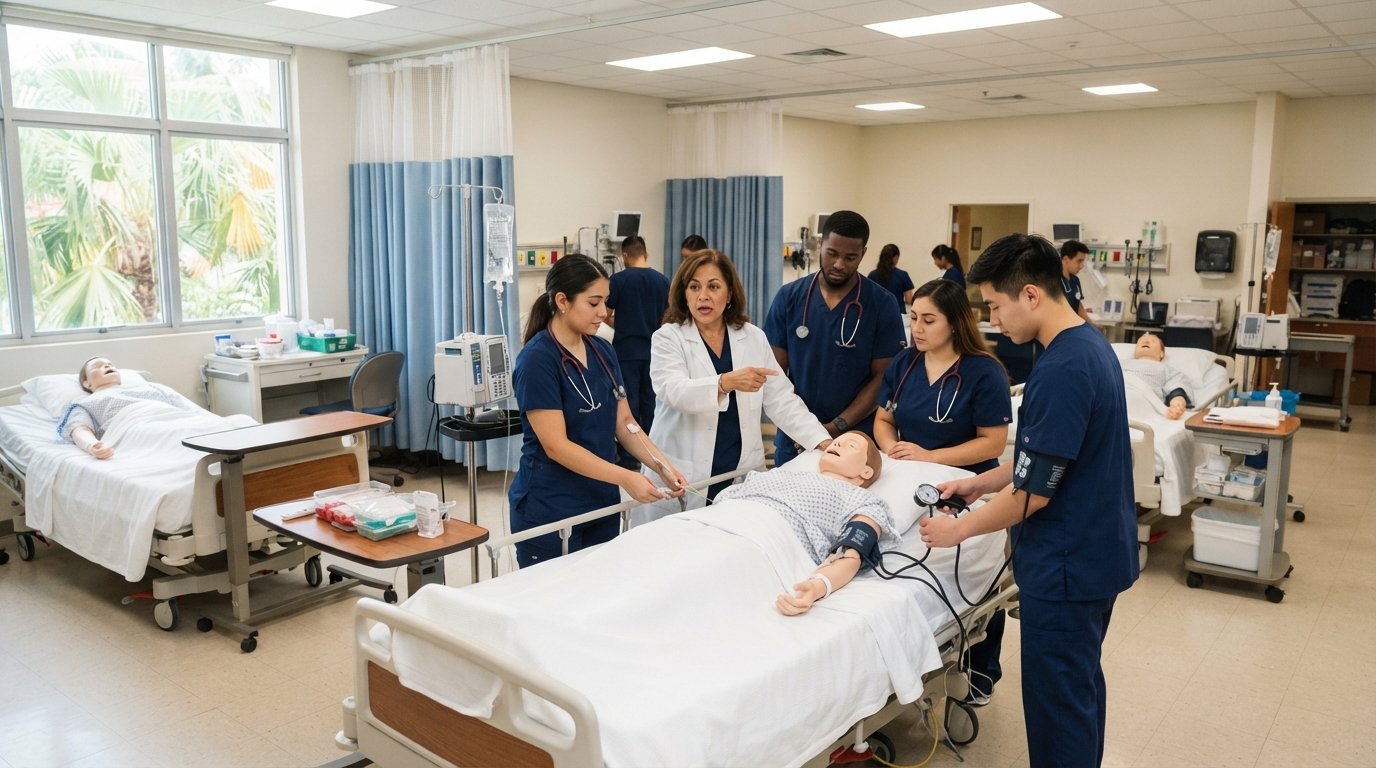
EDP University of Puerto Rico is a private, nonprofit institution with several campuses across the island, and its Villalba location serves students from the central mountain region and surrounding towns. The Nursing Science Bachelor's degree is structured as a four-year, in-person program, meaning students attend classes and labs on campus and complete supervised clinical rotations at affiliated healthcare facilities. This format is important: nursing is a practice discipline, and face-to-face instruction in simulation labs and clinical sites gives students repeated chances to build psychomotor skills, clinical judgment, and professional communication under instructor supervision.
The curriculum typically blends general education courses, foundational sciences, and nursing-specific coursework. Students can expect to take anatomy and physiology, microbiology, chemistry, and nutrition before or alongside introductory nursing courses such as fundamentals of nursing, health assessment, and pharmacology. Upper-level courses usually cover medical-surgical nursing, maternal-child nursing, pediatric nursing, mental health nursing, and community health nursing, with a leadership or management course near the end of the program. Clinical hours are embedded in these courses, and the exact sequence depends on the campus and cohort.
Because the program is in-person and cohort-based, students move through the major with the same group of peers, which can create strong study networks and peer support. That structure also means scheduling flexibility is limited: clinical placements may include early mornings, evenings, or weekend shifts depending on the facility. Prospective students should plan for a full-time commitment, especially in the junior and senior years when clinical demands increase.
Admission Requirements and What to Prepare
Admission to a nursing program is usually more competitive than general university admission, and EDP University Villalba is no exception. Requirements can change from year to year, so always confirm details with the admissions office, but most BSN programs in Puerto Rico expect a high school diploma or equivalent, official transcripts, and evidence of college readiness in math and science. Some programs require standardized test scores, while others may waive them for applicants who meet certain GPA thresholds.
Before starting nursing coursework, students often need to complete prerequisite courses with a minimum grade, frequently a C or better, in subjects like biology, chemistry, and anatomy and physiology. Meeting with an academic advisor early helps you map out prerequisites so you do not lose a semester. In addition to academics, nursing programs typically require health clearances, immunizations, background checks, and CPR certification before clinical placement. These are not admission deal-breakers, but they are non-negotiable steps once you enroll.
Here is a practical checklist to prepare your application:
- Request official transcripts from every school you have attended, including dual-enrollment or transfer coursework.
- Confirm the current prerequisite courses and minimum GPA with the nursing department, not just the general admissions office.
- Ask about the application deadline and whether there is a separate nursing application beyond the university application.
- Budget for pre-clinical costs such as uniforms, stethoscope, immunizations, and background check fees.
- Attend an information session or campus visit to see the simulation lab and meet faculty.
Completing these steps early reduces stress and helps you avoid surprises. If you are also exploring scholarship options for your degree, our guide on how to find and win bachelor's degree scholarship programs walks through search strategies and application timelines that apply to nursing students as well.
Cost, Financial Aid, and Funding Strategies
Cost is often the deciding factor for nursing students, and Puerto Rico offers some financial advantages compared with mainland U.S. programs. Tuition at private institutions in Puerto Rico is generally lower than at comparable mainland private colleges, and students who qualify for federal aid can use Pell Grants, Direct Loans, and work-study. Puerto Rico residents may also be eligible for local aid programs and institutional scholarships. The key is to file the FAFSA early and review your award letter carefully, because grants and loans are packaged differently at each school.
Beyond federal aid, nursing students can pursue scholarships from professional organizations, hospitals, and community foundations. Many hospitals offer service-for-scholarship arrangements in which they pay part of your tuition in exchange for a work commitment after graduation. These agreements can be valuable, but read the terms carefully: they often specify a minimum number of years and may require repayment if you leave early. Employer tuition assistance is another option if you already work in healthcare as a nursing assistant or medical assistant.
To keep costs manageable, consider this sequence:
- File the FAFSA as soon as it opens and list EDP University Villalba using the correct school code.
- Apply for institutional scholarships through the financial aid office, even small awards can reduce loan balances.
- Search national and local nursing scholarships, including those for minority students and bilingual speakers.
- Compare federal loans with private loans only after exhausting grants and scholarships.
- Track deadlines in a calendar and set reminders for renewal requirements.
For a broader look at college costs and planning tools, CollegeAndTuition offers resources on financial aid, scholarships, and college affordability that can complement your nursing program research. The more you understand about how aid is calculated, the better positioned you are to compare offers from multiple schools.
Clinical Training, Licensure, and Career Outcomes
The clinical component is the heart of the Nursing Science Bachelor's degree. At EDP University Villalba, students complete supervised rotations in hospitals, clinics, and community settings, applying classroom knowledge to real patients. Clinical instructors evaluate students on safety, communication, technical skills, and clinical reasoning. Students who struggle in clinical often need extra practice in the simulation lab, so it helps to use open lab hours and peer study groups proactively.
Graduates of a BSN program are eligible to sit for the NCLEX-RN, the national licensure exam required to practice as a registered nurse. Passing the NCLEX is a milestone, but it is not automatic: students should take a review course, use practice question banks, and study consistently in the final semester. Puerto Rico graduates who plan to work on the mainland should confirm licensure requirements in the state where they intend to practice, since state boards have different application processes and fees.
Career outcomes for BSN-prepared nurses are strong across the United States, and bilingual nurses are in demand in Puerto Rico and in mainland communities with Spanish-speaking populations. Common entry-level settings include hospital medical-surgical units, emergency departments, outpatient clinics, and long-term care facilities. With experience, nurses can pursue specialty certifications, graduate education, or leadership roles. The in-person format of the Villalba program can be an advantage here, because clinical instructors often provide mentorship and letters of recommendation that support job placement.
Is the In-Person Format at EDP University Villalba Right for You?
The four-year, in-person structure at EDP University Villalba suits students who learn best with direct faculty interaction and structured schedules. If you are a recent high school graduate, a career changer, or a working adult considering a full-time commitment, the program's cohort model can provide accountability and community. However, in-person attendance means you need reliable transportation to campus and clinical sites, and you may need to adjust work hours during clinical semesters.
Compare the program with other options before committing. Online or hybrid nursing programs exist, but they often require local clinical placements and may not suit students who need hands-on guidance. Accelerated BSN programs are available for students who already hold a bachelor's degree in another field, though they are intense. A traditional four-year BSN remains the standard path for students without prior college credit, and it offers a balanced pace for building clinical competence.
Before you decide, ask these questions during a campus visit:
- What is the program's NCLEX pass rate for recent cohorts?
- Which clinical sites are affiliated with the program, and how are placements assigned?
- What support services are available for students who need tutoring or academic advising?
- Are there scholarships specifically for nursing students, and how competitive are they?
- What is the typical course sequence, and how many semesters include clinical rotations?
Choosing a nursing program is a financial and personal decision, and the right fit depends on your learning style, support system, and career timeline. The Nursing Science Bachelor's degree, usually 4 years In-person at EDP University of Puerto Rico-Villalba, is a solid option for students who want a structured, clinically grounded education in a smaller campus environment. By planning your prerequisites, filing financial aid early, and visiting the campus, you can make an informed choice and start your nursing career on strong footing.