
Delta College Diesel Technician Associate's Degree: 2-Year Path
Train hands-on for a diesel technician career with Delta College's 2-year associate degree and learn how to fund tuition through grants and scholarships.

By Ella Thompson
A diesel engine powers more than just trucks. It moves freight across interstates, keeps ambulances running, drives farm equipment through harvest season, and supports the generators that back up hospitals. Behind every one of those machines is a trained technician who knows how to diagnose a failing injector, rebuild a transmission, and keep a fleet on the road. If you want to be that person, the Diesel Mechanics Technology/Technician Associate's degree, usually 2 years In-person at Delta College, is one of the most direct routes into the trade. It is hands-on, it is local, and it is built around the tools and systems you will actually touch on the job.
Delta College, located in Michigan's Great Lakes Bay Region, has offered career and technical education for decades. Its diesel program trains students on live equipment, from Class 8 tractors to hydraulics and electronic control systems. The format is in-person because diesel work is physical and mechanical: you cannot learn to torque a cylinder head through a video lecture. This guide covers what the degree includes, what it costs, how to pay for it, and what the job market looks like once you finish.
What the Diesel Mechanics Technology Associate's Degree Covers
The program blends general education with core technical coursework. You will spend time in classrooms learning theory, but the majority of your hours go to lab work. Delta College structures the degree so that students progress from basic engine fundamentals to advanced diagnostics. Early courses introduce you to diesel engine design, fuel systems, and electrical circuits. Later courses push into computerized engine controls, emissions systems, and powertrain rebuilding.
Because modern diesel engines are heavily electronic, the curriculum includes substantial training in scan tools, multimeters, and diagnostic software. You will learn to read fault codes, interpret live data streams, and trace electrical faults through complex harnesses. These skills separate technicians who can only swap parts from technicians who can actually solve problems. Employers consistently say they need the latter.
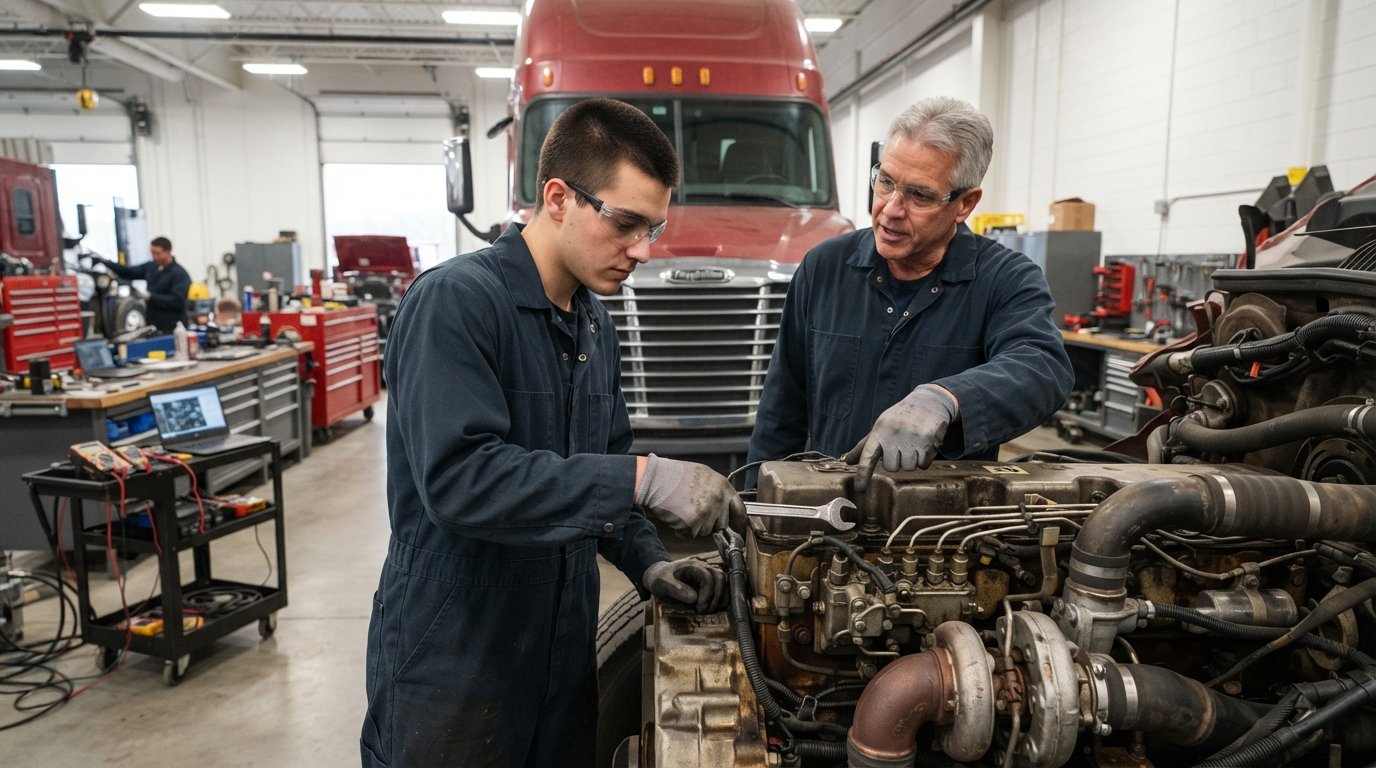
Hands-on labs use real engines and components. Students work on Cummins, Detroit Diesel, and other common platforms. You will disassemble and reassemble engines, test injectors, service aftertreatment systems, and practice preventive maintenance on trucks and heavy equipment. Safety training is built into every lab, covering everything from lifting techniques to proper use of personal protective equipment.
General education requirements typically include communication, mathematics, and maybe a technical writing course. These are not filler. Fleet managers expect technicians to write service reports, communicate with customers, and document warranty claims. Being able to explain a repair clearly is a career skill, not just an academic checkbox.
Core Technical Courses You Can Expect
While exact course titles vary, most diesel technology associate degrees include a set of foundational classes. At Delta College, students typically move through a sequence that builds from simple to complex systems. The following list reflects the kinds of courses that anchor the degree:
- Diesel Engine Fundamentals: theory of compression ignition, combustion cycles, and engine components
- Fuel Injection and Management Systems: mechanical and electronic fuel delivery, injector testing, and calibration
- Electrical and Electronic Systems: batteries, starting systems, charging systems, wiring diagrams, and scan tool operation
- Hydraulics and Pneumatics: fluid power principles used in heavy equipment, lifts, and braking systems
- Powertrain and Drivetrain: transmissions, clutches, differentials, and final drives
- Emissions and Aftertreatment: diesel particulate filters, selective catalytic reduction, and EPA compliance
Each of these courses includes both lecture and lab time. You will be quizzed on theory and graded on your ability to perform procedures correctly. By the time you reach the capstone courses, you should be able to diagnose a no-start condition, trace it to a failed sensor or wiring issue, and complete the repair with proper documentation.
Why In-Person Training Matters for Diesel Technicians
Online education has transformed many fields, but diesel mechanics is not one of them. The reason is simple: you need to feel the resistance on a wrench, hear the change in engine pitch when a cylinder misfires, and see how a component wears over time. These sensory experiences build intuition that no simulation can fully replicate.
In-person programs also give you access to equipment that most individuals cannot afford. A single diagnostic laptop for a modern diesel engine can cost thousands of dollars. A dyno, a cutaway engine, and a working hydraulic trainer are investments only a college or a large fleet can justify. When you train at Delta College, you use those tools under supervision, which means you make mistakes in a controlled environment instead of on a customer's truck.
There is also the matter of networking. In-person programs connect you with instructors who have worked in the field, classmates who will become colleagues, and employers who recruit directly from the program. Many students receive job offers before they graduate because a service manager visited the shop or called an instructor looking for a reliable entry-level technician. That kind of connection is difficult to build through a screen.
Finally, the structure of in-person training mirrors the structure of the job. You show up on time, you wear the right gear, you follow safety protocols, and you work as part of a team. Employers value these habits as much as technical skill, and a two-year program gives you time to develop them.
Admissions, Costs, and Financial Aid Options
Delta College maintains an open-admissions policy for most programs, which means you generally need a high school diploma or equivalent to apply. Some students place into developmental math or writing courses based on placement tests. It is worth taking those tests seriously, because a strong placement can save you a semester of prerequisite work.
Tuition for in-district students is significantly lower than for out-of-district or out-of-state students. Delta College serves a specific tax district, and if you live within it, your per-credit rate drops considerably. Books, tools, and personal protective equipment add to the total cost. Many diesel programs require students to purchase a basic tool set, which can run several hundred to over a thousand dollars depending on the kit.
Financial aid is available through the standard channels. You should complete the Free Application for Federal Student Aid, known as FAFSA, as early as possible. This opens access to Pell Grants, federal student loans, and work-study opportunities. Michigan also offers state-level aid programs, and Delta College has its own scholarship list. For a broader look at how degrees in technology fields translate into career growth, you can explore technology degree career pathways that connect classroom training to real jobs.
Beyond federal and state aid, consider these funding sources:
- Delta College Foundation scholarships, which are awarded based on need, merit, or program of study
- Trade association scholarships, such as those offered by trucking or equipment dealer groups
- Employer tuition assistance, if you already work for a fleet or dealership
- Workforce development grants through Michigan Works! or similar agencies
- Apprenticeship programs that combine paid work with classroom instruction
Scholarship.Education is a comprehensive resource for students seeking funding, and it is worth noting that the site receives compensation from listed schools through advertising, links, and search placement, which may influence how institutions appear in listings. That disclosure matters because it helps you evaluate information with clear eyes. The site does not claim to include every school, and it does not guarantee admission or job placement. Use it as one tool among many as you compare programs and funding options.
For students who want a wider view of higher education pathways, including how different degree levels compare, CollegeDegrees.School offers guides on college degrees and career planning that can help you map out a long-term plan. It is a useful complement to the specific program information you gather from Delta College and from scholarship databases.
Career Outcomes and Job Outlook for Diesel Technicians
The demand for diesel technicians is steady and, in many regions, growing. The Bureau of Labor Statistics projects employment for bus and truck mechanics and diesel engine specialists to remain stable or increase slightly over the next decade. Retirements in the existing workforce create openings even when overall employment is flat. Fleets, dealerships, independent shops, and government agencies all compete for qualified technicians.
Entry-level wages vary by region and employer. In Michigan, diesel technicians often start in the range of $18 to $24 per hour, with opportunities for overtime and shift differentials. Experienced technicians who specialize in diagnostics, emissions, or specific manufacturers can earn significantly more. Fleet technicians may receive benefits such as health insurance, retirement contributions, and tool allowances. Dealership technicians sometimes earn flat-rate pay, which rewards efficiency and skill.
Career advancement can take several forms. You might move from entry-level technician to lead technician, then to shop foreman or service manager. Some technicians transition into field service, traveling to repair equipment on site. Others open their own shops or become instructors. The associate degree helps because it signals that you have formal training and can handle both the technical and communication demands of the role.
One often overlooked advantage of diesel training is portability. The skills you learn apply to trucks, buses, agricultural equipment, construction machinery, marine engines, and stationary power generators. If one sector slows down, you can shift to another without starting over. That flexibility is valuable in an economy that can change quickly.
How to Succeed in the Program and Beyond
Success in a diesel technology program starts with attendance and engagement. Labs are sequential, and missing a session can put you behind on a procedure you will need later. Instructors notice who shows up prepared and who participates. Those are the students they recommend to employers.
Take math and writing seriously. You will use math to calculate torque values, gear ratios, and electrical resistance. You will use writing to document repairs and communicate with customers. A technician who can do both is more valuable than one who cannot.
Build relationships with classmates and instructors. Study groups help you prepare for exams, and classmates often share job leads. Instructors may write recommendation letters or make introductions to service managers. The network you build in a two-year program can support you for an entire career.
Stay current with technology. Diesel engines are changing rapidly, with tighter emissions standards and growing interest in alternative fuels. After you graduate, pursue manufacturer certifications and continuing education. Many employers pay for training that keeps your skills sharp. The more you learn, the more options you have.
Finally, treat your first job as a continuation of your education. Every repair is a chance to improve your diagnostic process. Every mistake is a lesson. Technicians who stay curious and take pride in their work tend to advance quickly, because the industry needs people who care about doing the job right.
The Diesel Mechanics Technology/Technician Associate's degree, usually 2 years In-person at Delta College, is a practical investment in a career that cannot be outsourced or automated away. It combines classroom theory with hands-on practice, connects you with employers, and prepares you for a job that keeps the economy moving. If you are ready to work with your hands, solve problems, and build something that lasts, this path is worth a close look.