
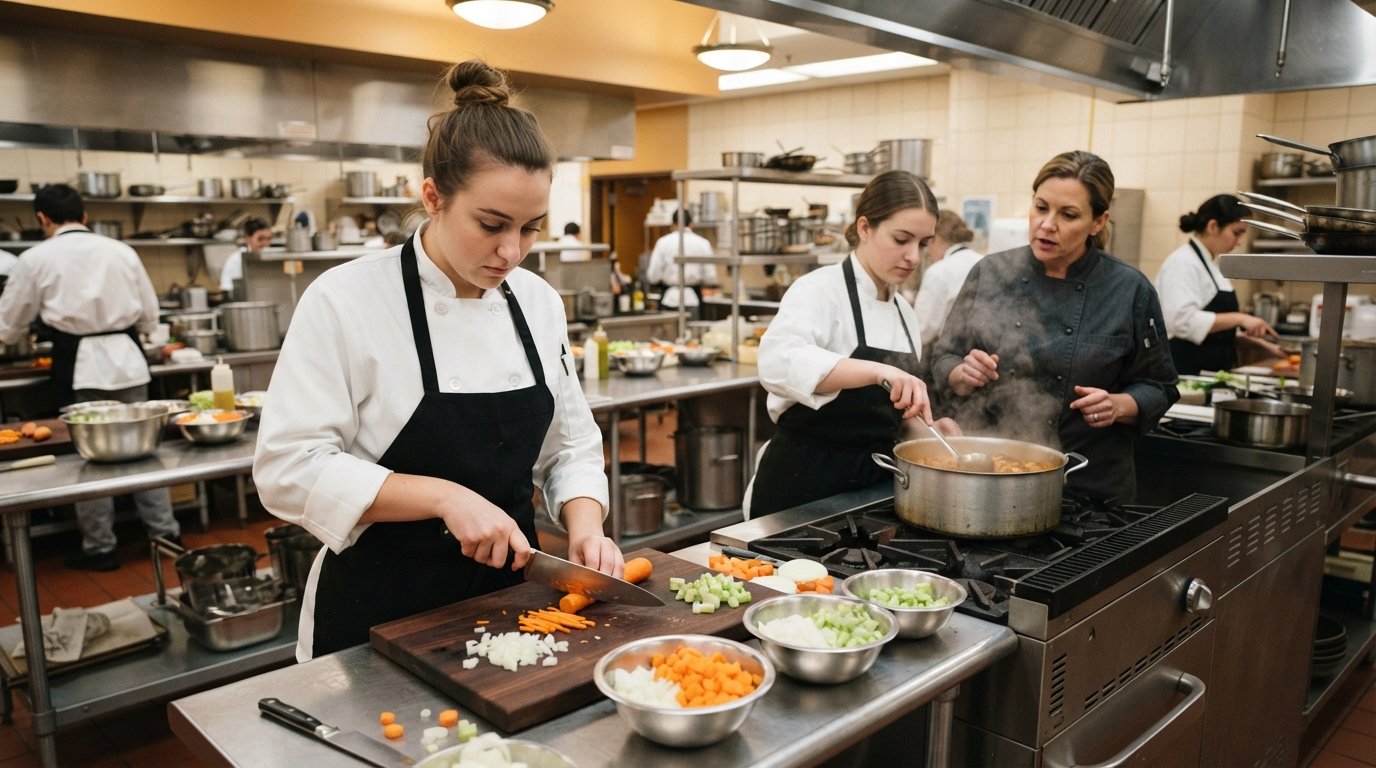
Culinary Arts Certificate at Blackhawk Technical College
Earn a Culinary Arts and Related Services Certificate, 1 year to less than 2 years In-person at Blackhawk Technical College and gain hands-on kitchen skills for a fast career start.

For students who want to work in a professional kitchen without committing to a four-year degree, the Culinary Arts and Related Services Certificate, 1 year to less than 2 years In-person at Blackhawk Technical College offers a focused, hands-on pathway into the food service industry. This program is designed for people who learn best by doing, who want to build knife skills, food safety knowledge, and line-cooking confidence in a real kitchen environment, and who want to enter the workforce quickly. Blackhawk Technical College, located in Janesville, Wisconsin, serves Rock and Green counties and has a reputation for career-focused training that aligns with local employer needs. The culinary certificate sits squarely in that mission: short, practical, and built around the skills that restaurants, hotels, hospitals, and catering companies actually hire for.
What makes this credential worth a closer look is its balance of speed and substance. You are not just taking a cooking class. You are completing a structured sequence of courses that covers sanitation, nutrition, purchasing, and production, usually within two to four semesters depending on your schedule and course availability. Because the program is delivered in person, you spend significant time in a commercial kitchen lab, working with industrial equipment, practicing timing under pressure, and receiving immediate feedback from instructors who have worked in the field. That in-person format matters in culinary education, where muscle memory, teamwork, and the ability to read a ticket during a dinner rush cannot be replicated through a screen.
If you are comparing options and wondering whether a certificate is the right move, consider the broader landscape of career training. Certificate programs in trades and services are often the fastest route to a living wage, and culinary arts is no exception. The Bureau of Labor Statistics projects steady demand for cooks and food preparation workers, with turnover in the industry creating consistent entry-level openings. A one-year to less-than-two-year certificate gives you a credible answer in an interview: you have formal training, you understand food safety regulations, and you have logged hours in a working kitchen. That can translate into a higher starting wage, a faster promotion to lead cook or shift supervisor, and a stronger foundation if you later decide to pursue an associate degree.
What the Culinary Arts and Related Services Certificate Covers
The curriculum at Blackhawk Technical College is built around the competencies that entry-level culinary employers expect. While specific course titles and sequencing can change, the core content typically includes sanitation and safety, basic and advanced food preparation, baking fundamentals, nutrition, cost control, and front-of-house service. You will learn how to receive and store food properly, how to use standard recipes and convert yields, how to manage a station during service, and how to plate food that looks as good as it tastes. Instructors emphasize professional habits: punctuality, clean uniform standards, knife safety, and communication during service.
Because the program is listed as "Related Services," it may also include exposure to hospitality operations beyond the kitchen. That could mean coursework in customer service, menu planning, or basic management principles. This breadth is useful if you are not certain whether you want to work on the line, in catering, in institutional food service, or in a front-of-house role. The certificate gives you a taste of several paths without forcing you to specialize too early. Students often discover that they prefer baking, or that they enjoy the pace of a la carte service, or that institutional settings like hospitals and schools offer more predictable hours and benefits.
Hands-on learning is the centerpiece. You should expect to spend a significant portion of your week in a kitchen lab, working in teams to produce meals for real or simulated service. This is not a lecture-only program. You will be on your feet, you will be timed, and you will be evaluated on both technique and professionalism. For many students, this is the most valuable part of the experience: it builds the stamina and situational awareness that line cooks need. It also gives you tangible items for a portfolio or a practical skills demonstration during a job interview.
Admissions, Cost, and Financial Aid for the Culinary Certificate
Blackhawk Technical College maintains an open admissions process, which means you do not need to have a high school GPA above a certain threshold or submit SAT scores to be considered. You will need to complete an application, provide proof of high school completion or equivalency, and possibly take a placement assessment for math and English. Because culinary coursework involves reading recipes, measuring ingredients, and basic cost calculations, placement testing helps ensure you start in courses where you can succeed. Some programs also require a brief interview or advising session before enrollment, so check with the college for current requirements.
Cost is a major consideration for any certificate program, and Wisconsin technical colleges are generally more affordable than four-year institutions. Tuition for a one-year to less-than-two-year certificate is typically charged per credit, and you should also budget for tools, uniforms, and knife kits. Many culinary programs require students to purchase a standard tool kit and chef's uniform, which can add several hundred dollars to the total. Books and supplies vary by course. The college's financial aid office can provide a current cost of attendance estimate that includes tuition, fees, and estimated living expenses.
Financial aid options for certificate programs include federal Pell Grants, Wisconsin state grants, institutional scholarships, and work-study. To apply, you will complete the Free Application for Federal Student Aid, or FAFSA. Certificate programs that are eligible for federal aid must meet certain requirements, so confirm with the financial aid office that the culinary certificate qualifies. Many students in short-term programs are surprised to learn that they can receive Pell Grant funding for a certificate, not just for a degree. You can also explore outside scholarships for career and technical education students, including awards from local restaurants, food service associations, and community foundations.
If you are exploring broader funding options, resources like CollegeDegree.Education can help you compare programs and understand how certificate training fits into a longer educational plan. The site connects prospective students with accredited colleges and universities, and it is useful for mapping out whether a certificate now could lead to an associate or bachelor's degree later. For students who want to keep costs down, starting with a certificate and then transferring credits into a degree program is a common strategy, provided you confirm transferability with the receiving institution.
How to Decide If This In-Person Certificate Is Right for You
The strongest candidates for this program share a few traits. They are willing to work early mornings, late nights, weekends, and holidays, because that is the reality of the food service industry. They are comfortable standing for long periods and working in a hot, fast-paced environment. They are team players who can take direction and communicate clearly. And they are looking for a credential that leads to employment quickly, rather than a broad liberal arts education. If that describes you, the certificate is worth serious consideration.
On the other hand, if you are unsure about the physical demands or the schedule, consider visiting the campus or talking to an advisor before enrolling. Some students benefit from starting with a single culinary course to test their interest before committing to the full certificate. Others know from experience in part-time restaurant jobs that they love the work and want formal training to move up. There is no single right path, but self-awareness about your tolerance for kitchen conditions and your career goals will help you make a good decision.
It also helps to think about where you want to work after graduation. Blackhawk Technical College has relationships with local employers in the Janesville and Beloit area, and culinary students often find jobs through internships, externships, or instructor referrals. If your goal is to work in a specific type of establishment, such as a scratch kitchen, a bakery, a hospital cafeteria, or a country club, mention that to your advisor early. They can help you tailor your elective courses and connect you with the right contacts. The certificate is a starting point, not a ceiling.
Career Outcomes and Next Steps After the Certificate
Graduates of the Culinary Arts and Related Services Certificate typically enter the workforce in roles such as prep cook, line cook, pantry cook, baker's assistant, catering assistant, or food service worker in institutional settings. With experience, they can move into lead cook, sous chef, or kitchen manager positions. Some graduates choose to continue their education, transferring into an associate degree in culinary arts or hospitality management. Others go directly into business ownership, though that usually requires additional experience and capital. The certificate gives you a credible foundation and a network of instructors and alumni who can help you navigate the early stages of your career.
Earnings vary by region, establishment type, and experience. Entry-level cooks in Wisconsin generally earn an hourly wage that is above the federal minimum but modest, with opportunities for overtime and tips in some settings. The path to higher pay usually involves specialization, leadership responsibility, or moving into a management role. Because the industry has high turnover, reliable, well-trained workers are valued, and a certificate signals that you have made a commitment to the profession. Over time, the combination of formal training and consistent work experience can lead to supervisory and executive chef roles.
For students who want to keep their options open, the certificate can also serve as a stepping stone to related fields such as dietetics, food science, hospitality management, or nutrition education. If you are interested in the health side of food, you might consider pairing culinary training with coursework in nutrition. If you are interested in the business side, you might pursue additional training in hospitality management or entrepreneurship. The key is to treat the certificate as one component of a longer career plan, not as an endpoint.
Paying for Your Culinary Training: Practical Advice
Funding a short-term certificate program requires a different strategy than funding a four-year degree. Because the total cost is lower, smaller scholarships and grants can make a big difference. Start by completing the FAFSA as early as possible, since some aid is awarded on a first-come, first-served basis. Then look for local scholarships from community organizations, employers, and industry groups. Restaurants and food service companies sometimes offer tuition assistance or reimbursement for employees who pursue culinary training, so ask your current employer if that benefit exists. Blackhawk Technical College's foundation may also offer scholarships specifically for career and technical education students.
It is also worth considering how you will balance work and school. Many culinary students work part-time in restaurants while enrolled, which provides income and experience but can also lead to burnout if not managed carefully. The in-person format of this program requires a consistent time commitment, so you will need to plan your work schedule around lab sessions and lecture times. Advisors can help you map out a course sequence that fits your life, and some students spread the certificate over four semesters to reduce weekly hours. There is no penalty for taking a slightly slower pace if it helps you succeed.
Finally, keep good records of your expenses and aid. If you receive a scholarship, understand whether it is renewable and what the renewal requirements are. If you take out a loan, borrow only what you need and understand the repayment terms. The financial aid office is there to help, and asking questions early can prevent surprises later. Culinary training is an investment in your skills, and like any investment, it benefits from careful planning and clear expectations.
Choosing the Culinary Arts and Related Services Certificate, 1 year to less than 2 years In-person at Blackhawk Technical College is a decision to invest in practical skills and immediate employability. The program is short, hands-on, and aligned with the needs of local employers, making it a strong option for students who want to start working in the food service industry without the time and expense of a longer degree. With careful planning around cost, financial aid, and scheduling, you can complete the certificate and step into a kitchen with confidence, ready to learn, grow, and advance.