
Automation Engineer Associate's Degree at CSI: 2-Year Guide
The Automation Engineer Technology/Technician Associate's degree at College of Southern Idaho takes about two years in person and leads straight into high-demand controls jobs.

By Isaac Griffin
Manufacturing floors across Idaho are changing fast. Sensors, robots, and programmable logic controllers now run tasks that once required dozens of hands, and someone has to keep those systems calibrated, connected, and safe. That someone is the automation technician, and the fastest reliable route into the field is an Automation Engineer Technology/Technician Associate's degree, usually 2 years In-person at College of Southern Idaho. For students who want a hands-on, employable credential without a four-year commitment, this program sits at a rare intersection of technical depth, local employer demand, and manageable cost.
This guide walks through what the degree covers, how the in-person format works in your favor, what it costs, how to pay for it, and how to turn the credential into a paycheck in Twin Falls and beyond. If you are comparing training pathways, it also shows how a two-year automation degree stacks up against certificates, bachelor's degrees, and online options.
What the Automation Engineer Technology/Technician Associate's Degree Covers
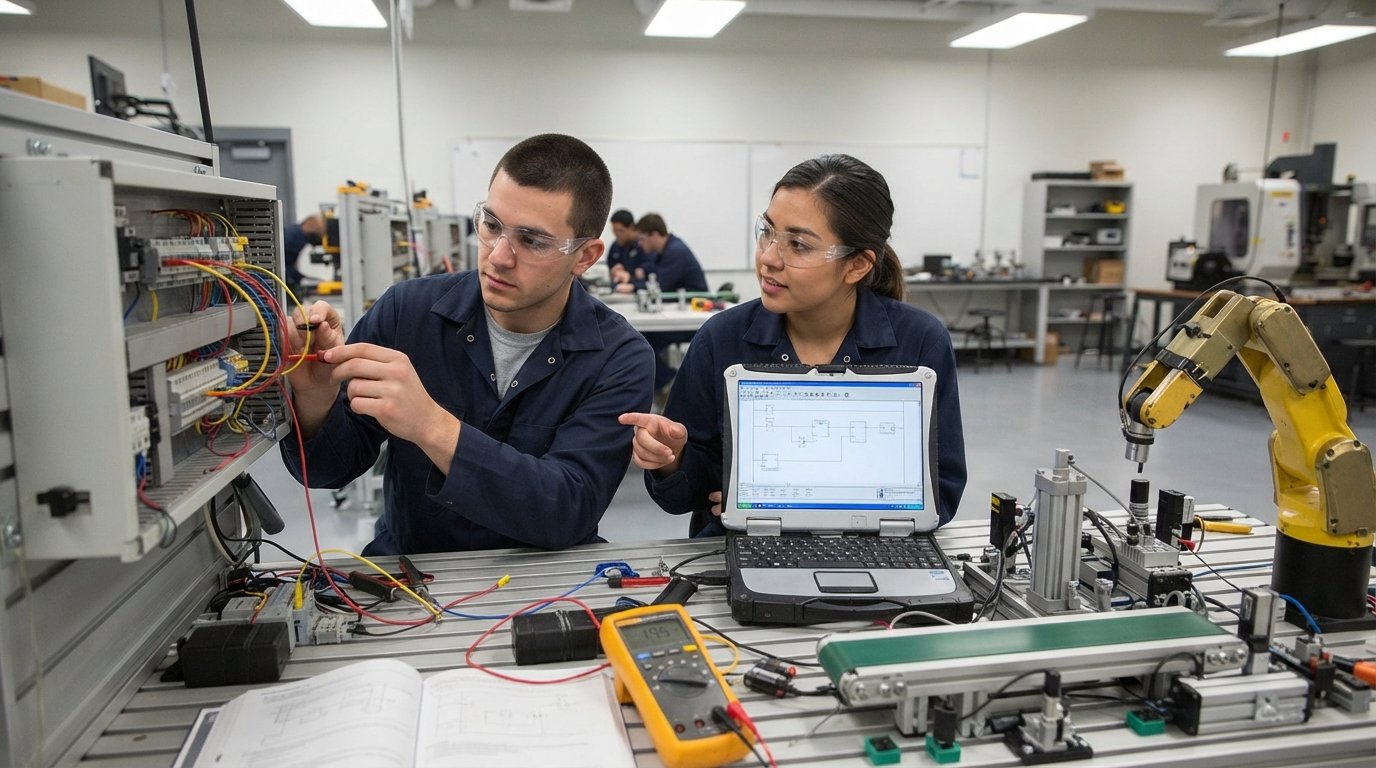
The program is built around the equipment students will actually touch on the job: programmable logic controllers (PLCs), industrial robotics, motor controls, sensors, hydraulics and pneumatics, and the networking that ties it all together. Coursework typically blends electrical theory with hands-on labs, so students learn to read schematics, wire control panels, program ladder logic, and troubleshoot a line that has stopped moving. General education requirements round out the degree, but the center of gravity is applied, lab-based learning.
Because the credential is an Associate of Applied Science style degree, the emphasis stays on employment rather than transfer. Graduates are prepared for roles such as automation technician, controls technician, maintenance technician, electromechanical technician, and manufacturing engineering aide. In a region with food processing, dairy, agriculture equipment, and advanced manufacturing employers, those titles appear on job boards constantly.
Students should expect a sequenced curriculum. Early semesters build electrical and mechanical foundations; later semesters move into PLC programming, robotics, process control, and a capstone or internship experience. That progression matters because automation work rewards people who understand the whole system, not just one component. A technician who can trace a fault from a sensor through a PLC to a drive motor is far more valuable than one who only knows how to swap parts.
Why the In-Person Format at College of Southern Idaho Matters
Automation is a physical discipline. You cannot learn to tune a PID loop, align a photo eye, or safely lock out a panel from a video lecture alone. The in-person requirement at College of Southern Idaho exists because the program depends on lab equipment: training rigs, robots, controllers, and instrumentation that students program and troubleshoot with an instructor nearby. That supervised repetition builds the muscle memory employers test for during interviews and onboarding.
There is also a safety dimension. Industrial automation involves voltages, moving machinery, and pressurized systems. Learning proper lockout/tagout procedures, arc flash awareness, and panel safety under direct supervision is not optional, and it is one of the strongest arguments for a face-to-face program over a fully online alternative. Employers know this, which is why they tend to trust hands-on associate degrees when hiring for the plant floor.
The location adds another layer of value. The College of Southern Idaho sits in Twin Falls, a short drive from major food processing and manufacturing operations that hire technicians steadily. That proximity supports internships, guest speakers, advisory board input on curriculum, and job placement conversations that happen long before graduation. Students who treat the program as a two-year networking opportunity often walk out with offers in hand.
Admission Steps and Program Planning
Admission to a two-year technical program is generally straightforward, but a little planning prevents wasted semesters. Most students move through a predictable sequence, and starting early on math placement and financial aid paperwork keeps the timeline at four semesters rather than five or six.
- Apply to the college and submit official high school transcripts or equivalency documents.
- Complete placement assessments in math and English, then enroll in any developmental courses needed before technical coursework.
- Meet with an academic advisor to map the full two-year sequence and confirm lab availability by semester.
- File the FAFSA and apply for institutional and local scholarships before priority deadlines.
- Attend program orientation to learn lab safety rules, tool requirements, and internship expectations.
That fourth step deserves emphasis. Automation students are eligible for federal student aid, state grants, institutional scholarships, and workforce development funding tied to in-demand fields. Idaho has repeatedly classified advanced manufacturing and technical roles as high-demand areas, which unlocks targeted grant programs beyond the standard aid package. Students who file early and ask the financial aid office specifically about workforce-ready grants often find money that never appears on a generic scholarship search.
Cost, Financial Aid, and Funding Strategies
A two-year public college credential is one of the best values in higher education, but the bill is still real. Costs include tuition, fees, lab supplies, tools, and possibly a laptop capable of running programming software. Textbooks and safety gear add to the total. The good news is that the funding stack for technical students is deeper than most families realize.
- Federal Pell Grants and Supplemental Educational Opportunity Grants, which do not require repayment.
- Idaho state grants and workforce training funds aimed at high-demand technical fields.
- Institutional scholarships from the college, including awards reserved for technical and trades students.
- Employer tuition assistance and apprenticeships, often available from manufacturers that partner with the program.
- Federal work-study and low-interest federal loans as a backstop after grants and scholarships.
The strategic move is to treat grants and scholarships as the first layer, employer sponsorship as the second, and loans as the last resort. Many automation employers will pay part or all of tuition for working students, sometimes in exchange for a commitment to stay after graduation. That arrangement can turn a two-year degree into a near-zero-debt proposition, and it is worth asking about during informational interviews and plant tours.
Students who want a broader view of how technical and business credentials fit together can explore business and technology degree pathways, which helps frame decisions about whether to stack a bachelor's degree later. And for students weighing multiple schools and programs at once, a matching service like CollegeDegree.Education can simplify the search by connecting prospective students with accredited colleges, universities, and degree programs that fit their goals, schedule, and budget.
Automation Careers, Salaries, and Advancement
Entry-level automation and controls technicians typically start in a range that supports a comfortable living in southern Idaho, and pay climbs quickly with certifications and experience. Exact figures vary by employer, shift, and industry, but the pattern is consistent: technicians who can program and troubleshoot earn meaningfully more than those who only perform mechanical maintenance. Night shifts and on-call rotations often carry premiums, which matters for students planning their first few years.
Advancement paths are clear and well-traveled. A technician can move into senior technician roles, controls specialist positions, maintenance supervision, or engineering support. Many employers will fund additional training in specific platforms, such as particular PLC brands or robotics systems, because vendor-specific skills are directly useful on their lines. Others encourage technicians to pursue a bachelor's degree in engineering technology or industrial technology part-time while working, often with tuition reimbursement.
The degree also travels. Automation skills are not tied to one industry: food processing, logistics, pharmaceuticals, automotive suppliers, water treatment, and energy all depend on controls technicians. That portability is a hedge against layoffs and a reason the credential holds value even if a student later relocates.
Comparing the Two-Year Degree to Alternatives
Prospective students often ask whether a certificate, an associate degree, or a bachelor's degree is the right call. The honest answer depends on timeline, budget, and career goals, and each path has tradeoffs worth understanding before enrolling.
- Certificate programs: Faster and cheaper, but narrower. They can get you into entry-level maintenance work, yet they often lack the math, networking, and general education depth employers look for in automation roles.
- Associate degree (this program): The sweet spot for most students. Two years, hands-on labs, broad enough for multiple technician titles, and eligible for the full range of financial aid.
- Bachelor's degree: Stronger for engineering-track roles and management, but four years and significantly more cost. Many students pursue it later with employer support.
- Fully online alternatives: Convenient for theory, but weak for hands-on automation skills. Lab access and supervised safety training are hard to replicate remotely.
For students whose goal is to be employable in a plant within two years, the associate degree is usually the most efficient route. It leaves the door open to a bachelor's later without requiring it up front, and it qualifies for aid programs that short certificates sometimes miss.
How to Succeed Once You Enroll
The students who get the most out of an automation program treat it like a job. Attendance in labs matters because equipment time is limited, and the students who stay after class to practice programming or ask instructors about real faults they saw at work consistently graduate with stronger skills. Forming study groups for electrical theory and PLC logic pays off, since troubleshooting is a team sport on the plant floor.
Internships and part-time maintenance work are the other big lever. Even a summer internship at a food processing plant gives students context that makes coursework click, and it puts them in front of hiring managers months before graduation. Students should also build a simple portfolio: photos of completed lab projects, a list of platforms they have programmed, and any certifications earned along the way. That portfolio often matters more in interviews than a transcript.
Finally, students should stay curious about the direction of the field. Automation is moving toward more networked systems, data collection, and predictive maintenance, and technicians who understand basic networking and data literacy will have an edge. The two-year degree provides the foundation; the habit of continuous learning provides the career.
An Automation Engineer Technology/Technician Associate's degree, usually 2 years In-person at College of Southern Idaho, is a practical, affordable on-ramp to a field that keeps hiring. It rewards students who show up, touch the equipment, and connect with local employers early. For anyone who likes solving physical problems with logic and tools, it is one of the most direct paths from classroom to plant floor.