
Atlantic Cape Nursing Associate Degree: 2-Year Path
The Registered Nursing/Registered Nurse Associate's degree, usually 2 years In-person at Atlantic Cape Community College, offers a faster, lower-cost route to RN licensure.

Every semester, thousands of aspiring nurses face the same frustrating math: four-year BSN programs can cost six figures and take half a decade to finish. But there is a faster, more affordable route hiding in plain sight at community colleges across the country. The Registered Nursing/Registered Nurse Associate's degree, usually 2 years In-person at Atlantic Cape Community College, is one of the clearest examples of how to enter the nursing profession with less debt and a quicker start on earning. This program, offered at the Mays Landing campus in New Jersey, prepares students to sit for the NCLEX-RN exam and step directly into staff nurse roles in hospitals, clinics, and long-term care facilities.
What makes this pathway worth serious attention is the combination of speed, cost, and hands-on training. You are not learning from a screen in a vacuum. You are practicing clinical skills in simulation labs and real patient settings, guided by instructors who have worked the floor. If you are weighing nursing school options, understanding exactly what this associate degree delivers (and what it does not) will help you make a decision grounded in reality rather than marketing brochures.
Why the Associate Degree in Nursing Remains a Smart Entry Point
The associate degree in nursing, often called an ADN, has been the backbone of American nursing education for decades. It exists specifically to get competent, licensed nurses into the workforce quickly. At Atlantic Cape Community College, the program is designed around a simple promise: complete roughly two years of full-time study, pass the NCLEX-RN, and you are eligible for entry-level registered nurse positions. That timeline matters enormously for students who cannot afford to pause their earning years for a four-year degree.
Cost is the other half of the equation. Community college tuition, even for out-of-county students, is dramatically lower than private university tuition. For New Jersey residents, the per-credit rate at a county college is a fraction of what a four-year institution charges. When you add in the ability to live at home and commute, the total cost of attendance can be less than a single year at many universities. That financial reality is why so many career changers and working adults choose this route.
The degree also functions as a stepping stone. Many ADN graduates later complete an RN-to-BSN bridge program online while working full time, often with employer tuition assistance. That means you can start earning a real nursing salary in two years, then let your employer help pay for the bachelor's degree later. It is a financially disciplined sequence that avoids the trap of accumulating large debt before earning a single paycheck.
What the Atlantic Cape Nursing Program Actually Looks Like
Atlantic Cape Community College offers the nursing associate degree at its Mays Landing campus, with clinical rotations arranged at partner healthcare facilities throughout Atlantic and Cape May counties. The program is structured as a cohort model, meaning you move through the curriculum with the same group of students. This is not incidental: nursing programs use cohorts because they build study groups, accountability, and peer support, all of which matter when the material gets demanding.
Admission is competitive. You do not simply enroll in nursing courses on day one. Students typically complete prerequisite courses in anatomy and physiology, microbiology, chemistry, and English composition before applying to the nursing program itself. Many students spend a semester or two finishing those prerequisites, then apply for a seat in the clinical phase. This is why the phrase "usually 2 years" comes with an asterisk: the nursing coursework itself takes about two years, but the full journey from first class to degree can stretch to three years depending on your starting point.
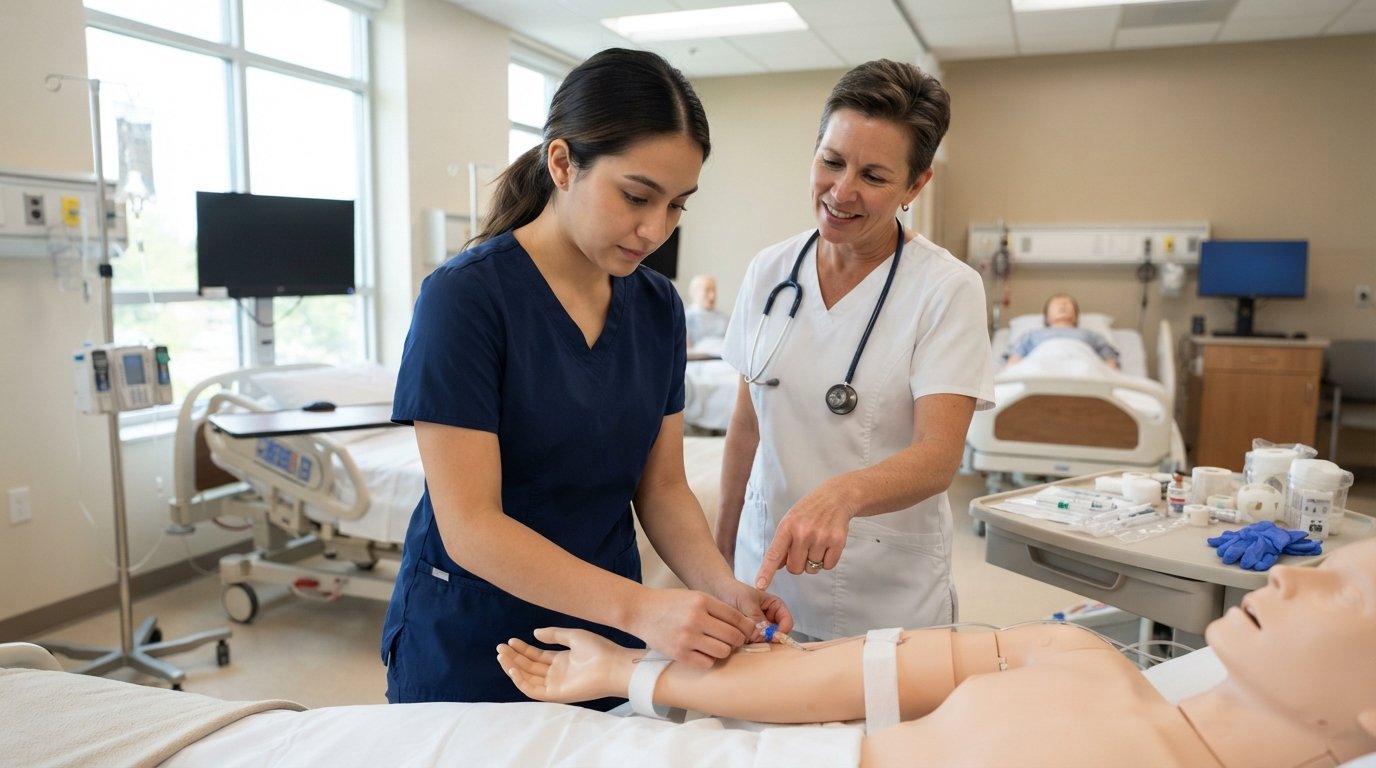
Once admitted, the clinical phase blends classroom instruction with supervised patient care. You will study medical-surgical nursing, maternal and pediatric care, mental health nursing, and community health. Simulation labs give you a safe space to practice injections, catheterizations, and patient assessments before you touch a real patient. Clinical placements then put you in hospitals and care facilities under the supervision of licensed nurses and clinical instructors.
Typical Prerequisites and Admission Steps
Understanding the sequence helps you plan realistically. Most students follow a path like this:
- Apply to Atlantic Cape Community College as a general health sciences or nursing interest student.
- Complete prerequisite courses (anatomy and physiology I and II, microbiology, college writing, and often psychology or statistics) with competitive grades.
- Take the required entrance exam (often the TEAS or a program-specific assessment) and submit your nursing program application by the stated deadline.
- Attend orientation and begin the clinical nursing sequence once admitted to the cohort.
Each step has a deadline, and missing one can push your start date back by a full semester. Prospective students should meet with an academic advisor early, ideally during their first semester of prerequisites, to map out the exact sequence. Advisors know which courses fill up fast and which semesters offer the best chance of admission.
Costs, Financial Aid, and Funding Strategies
Nursing school is an investment, but the associate degree model keeps the initial outlay manageable. Tuition at a New Jersey county college is typically billed per credit, and the nursing program's credit load is substantial because of clinical hours. Beyond tuition, budget for lab fees, uniforms, stethoscope and clinical supplies, background checks, drug screening, CPR certification, and NCLEX preparation materials. These add up, and students who plan for them avoid unpleasant surprises mid-semester.
Financial aid is available at multiple levels. The Free Application for Federal Student Aid (FAFSA) is the starting point for Pell Grants, federal work-study, and subsidized loans. New Jersey also offers state-level tuition assistance programs for residents, and Atlantic Cape's financial aid office can help students identify institutional scholarships and payment plans. Working adults should ask employers about tuition reimbursement, which many healthcare organizations offer even to part-time employees.
Scholarships specifically for nursing students are another powerful lever. Professional nursing associations, hospital foundations, and community organizations award funds to students pursuing RN licensure, and many of these awards go unclaimed simply because students do not apply. For a deeper walkthrough of the application process and how to position yourself for major awards, see this guide on securing full ride nursing scholarships. Combining small local awards with federal aid and employer support can dramatically reduce out-of-pocket costs.
Students exploring all their degree options, including four-year and online alternatives, can use matching tools to compare programs side by side. Resources like CollegeDegree.Education connect prospective students with accredited colleges and degree programs, which is useful when you want to weigh an ADN against a BSN or explore bridge pathways. The key is to compare total cost, time to licensure, and NCLEX pass rates rather than sticker price alone.
Clinical Training, Licensure, and Career Outcomes
The value of an in-person nursing program lives in its clinical training. Atlantic Cape students rotate through medical-surgical units, obstetric and pediatric settings, and community health placements. These rotations are where classroom theory becomes muscle memory: reading a patient's chart, recognizing a change in condition, communicating with a care team. Online programs can teach pharmacology, but they cannot replicate the experience of standing at a bedside with an instructor guiding your assessment.
Graduates are eligible to sit for the NCLEX-RN, the national licensing exam required to practice as a registered nurse. Passage rates matter when evaluating any program, and prospective students should ask the college for its most recent first-time NCLEX pass rate. A strong pass rate signals that the curriculum and clinical preparation are aligned with what the exam actually tests.
Career outcomes for ADN-prepared RNs are solid, particularly in New Jersey, where hospitals, long-term care facilities, home health agencies, and outpatient clinics all hire associate-prepared nurses. Starting salaries vary by setting and shift, but nursing offers something few fields can match: shift differentials, overtime opportunities, and genuine job security. Many employers also offer tuition assistance for RN-to-BSN completion, which means the associate degree can be the first step rather than the final one.
It is worth being honest about the tradeoffs. Some hospitals, particularly Magnet-designated facilities, prefer or require BSN-prepared nurses for certain roles, and leadership or specialty positions often demand a bachelor's degree. The associate degree gets you licensed and employed; advancement may require additional education. For students who plan to bridge to a BSN within a few years, this is a manageable tradeoff. For those who want to work in highly specialized areas immediately, a four-year program may align better with long-term goals.
Is This Program Right for You?
The Registered Nursing/Registered Nurse Associate's degree, usually 2 years In-person at Atlantic Cape Community College, fits a specific profile: students who want to become licensed RNs quickly, who learn best with hands-on clinical experience, and who value low tuition over campus prestige. It also suits career changers who need to keep costs down and working adults who can arrange their schedules around daytime clinical rotations.
Before applying, visit the campus, attend an information session, and speak with current students or recent graduates. Ask about NCLEX pass rates, clinical site locations, and how the program supports students who struggle academically. Nursing school is rigorous, and the programs that support students well are the ones where graduates succeed. Planning your finances early, applying for scholarships, and mapping prerequisites with an advisor will put you in the strongest position when application season arrives.